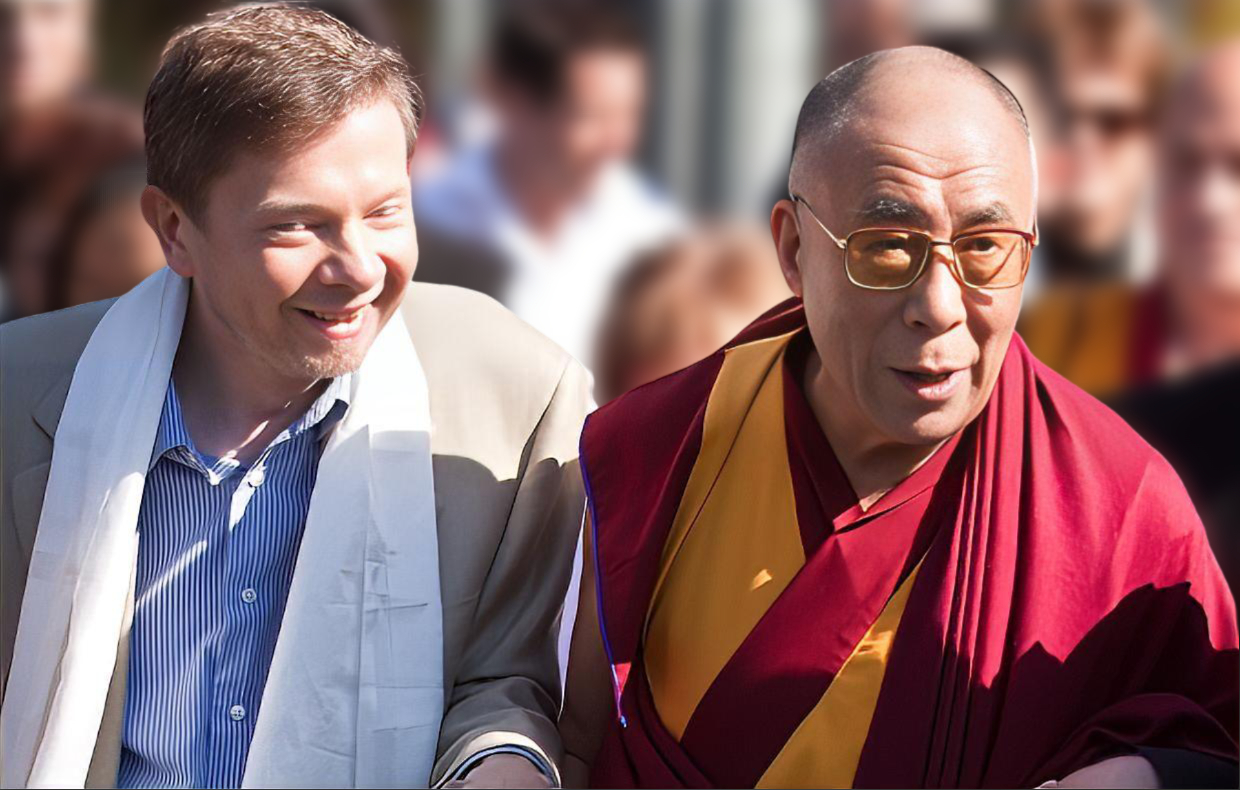
Bestselling self-help author Eckhart Tolle is the most renowned and successful independent spiritual teacher in the western world. Here he’s pictured with the Dalai Lama at the Vancouver Peace Summit in 2009.
Eckhart Tolle is a spiritual megastar. He is much more than bestselling self-help author beloved by celebrities; he is also the most influential independent spiritual teacher in the world—even viewed as being in the same league as the Pope or Dalai Lama.[1] Oprah Winfrey, who co-hosted a webinar series with him that reached tens of millions, has called him “a prophet for our time.”[2] His books have sold millions of copies and been translated into more than 30 languages.[3] He has amassed millions of followers on YouTube and Instagram; thousands continue to pay a premium to hear him teach in person.
But I’ve discovered that his work shares conspicuous, unacknowledged correspondences with earlier contemporary authors: far too many for everything I have unearthed to be coincidental. My close comparisons reveal that Tolle restates the ideas, phrases and views of certain authors with surprising regularity.
Tolle’s self-help teachings, first propelled to popularity by Oprah in the early 2000s, centre on being more conscious or “present” in the moment.[4] They’re generally seen as a New Age distillation of eastern wisdom, such as Buddhist mindfulness, blended with Christian references and some western philosophy, like stoicism. But I believe Tolle’s most important influences are actually much closer to home: namely, lesser-known western spiritual teachers of the 20th century.
Most of my comparative analysis, presented at this site, is focused on the British Fourth Way teacher Maurice Nicoll, who is perhaps the least known of the writers I’ve looked at. Most of his work was published in the mid-1950s; some posthumously. Another major influence was Barry Long, an independent spiritual teacher and author from Australia, who Tolle encountered in London in the 1980s about 15 years before his debut book appeared.
A complete outline of all my research articles, which present comparative analyses of these and other authors with the work Tolle, can be found on the About page. You can also access them by browsing the homepage. In this article, I’ll give an overview of some of my key findings.
Some may wonder: why does any of this matter? In short, if a famous writer does not acknowledge sources they have drawn upon extensively, it surely matters. That can constitute plagiarism, which is a serious ethical breach. That’s the short answer. This article is my attempt to address this question in more depth.
To begin with, I’ll set out below why I think Tolle owes a debt to certain authors, based on my findings, and showcase some prominent examples from my research to demonstrate this. Then I’ll discuss the ethical, cultural and spiritual ramifications of his lack of acknowledgment, and explain why I believe he ought to clearly acknowledge his sources.
Fourth Way teacher Maurice Nicoll’s influence on Eckhart Tolle
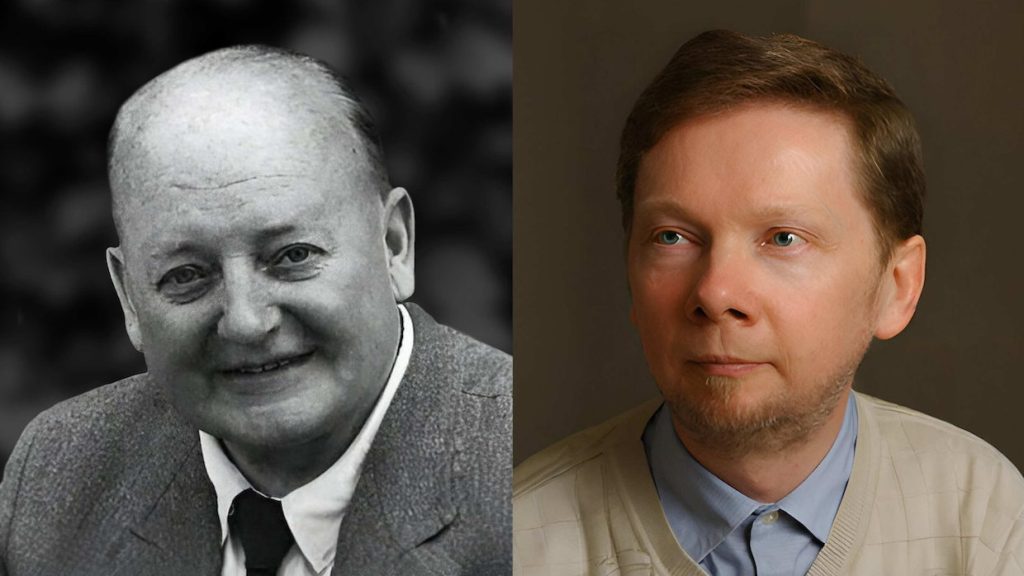
Maurice Nicoll (L) and Eckhart Tolle (R)
Maurice Nicoll, born 1884, was a successful British psychiatrist and friend of the famous psychologist Carl Jung. He put aside his medical career to study, and then teach, the esoteric system known as The Fourth Way, far from the limelight, until his death in 1953.
I discovered hundreds of closes correspondences between Nicoll and Tolle, which I’ve detailed in a series of articles. They not only teach comparable ideas, but often use similar terms, language and descriptions too.
For example, both tell us to hone “the power of self-observation” and use this practice to bring our unconscious thoughts, emotions and reactions “into the light of consciousness.” This can transform our inner state and give us “the power of choice” over our reactions, they say. I’ve quoted exact phrases both use, but each phrase also encapsulates a broad topic of close correspondences I have written about.
To give another example: when I compared similar segments about dealing with repetitive, negative thought monologues, I found they used the same expressions and analogies.
Nicoll calls this kind of habitual thinking “inner talking” in his paper on the topic. He describes this as a mental “monologue” or “mumbling” that’s “difficult to stop.” Some persistent thought monologues recur in us like “old laid down gramophone records,” he says. The case of “people who go along in the streets muttering to themselves” is also a form of it, but typically it’s “not expressed outwardly.”[5]
Whereas Tolle, under the heading “Freeing yourself from your mind,” calls this phenomenon “the voice,” which consists of “continuous monologues or dialogues” that are “involuntary and compulsive.” These can repeat like “old gramophone records . . . playing in your head.” This mental voice is not very different to “people in the street incessantly talking or muttering to themselves,” he says, it’s just that most “don’t do it out loud.”[6]
I’ve bolded equivalent—sometimes near-identical—phrases. While addressing rampant uncontrolled, negative thoughts is a fairly common spiritual, psychological or self-help theme, to match so explicitly in their descriptive language—both mention old gramophone records and people muttering to themselves in the street—is unusual. They also propose the same solution to deal with this negative inner monologue: start observing it and stop identifying with it.
Are these parallels just a coincidence though? If viewed in isolation, you might stretch the argument that it’s a fluke. It is surely unlikely that two writers would randomly use the same peculiar expression, “gramophone records,” to describe the same process and also make the same comparison to people “muttering to themselves” in the street, but it is perhaps not impossible.
However, this is not an isolated case. There are hundreds of conspicuous correspondences to consider. I think there are far too many instances for all to be coincidental. I’m not asking anyone to just take my word for it though: people can view my articles presenting side-by side comparisons of their words here, and make up their own minds.
More examples of some of their correspondences are presented in the slideshow below. If you cycle through these statements, you will notice a broader pattern emerging. There is not just a recurrence of similar terms, expressions and examples, but of core ideas and messages. In other words: they closely correspond in both style and substance, in fundamental ways, in what they teach.
View quotes in a table with citations
Nicoll and Tolle correspond on far more esoteric ideas too. For example, Nicoll writes that we have a “time-body” storing our “living past”[7]—including our negative emotions and suffering.[8] “When two people marry they do not only marry their physical bodies but they marry their Time-bodies,” he says.[9] Our negative time-bodies can be transformed by the light of consciousness through living “more consciously now.”[10]
Tolle similarly maintains that you accumulate negative emotional pain in your “pain-body”[11] which “is the living past in you.”[12] “You don’t just marry your wife or husband, you also marry her or his pain-body,” he writes.[13] Your emotional pain-body can be transmuted by the light of your consciousness when you access “the power of Now.”[14]
While it’s too much to get into here, they essentially describe the same practice to cleanse the negativity said to exist in these psychic bodies too, among other parallels, shown here.
These particular concepts are quite distinctive; they are not your run-of-the-mill spiritual topics. Having looked into this closely, I can see how the ideas of G.I. Gurdjieff and his most famous pupil, P.D. Ouspensky—who together introduced The Fourth Way to the West—combine in a novel way with those of the psychologist Carl Jung, when Nicoll relates his idiosyncratic views on the “time-body” and how to transform it. Nicoll is very unique in having studied personally all three of these luminaries. So it’s not just telling that Tolle’s language is so alike here: it is striking that he covers such similar ground at all.
Yet there is more to the story here. I argue that Tolle’s pain-body is actually a composite of ideas presented by Nicoll and Barry Long. Believe it or not, Tolle’s correspondences with Long on this topic are even more pronounced; I’ll touch on that further on.
There are far too many strange similarities between Tolle and Nicoll to mention them all here. In addition to the side-by-side comparisons I have published, I’ve also written essays with more in-depth analysis. These examine how their ideas correspond in greater detail, explore the historical background to the concepts, and also look at some major ways the authors diverge.
I’ll mention just a few more prominent correlations here. Nicoll sometimes called the act of being more conscious in the present moment “the creation of now;” Tolle would later call this “the power of Now.” Nicoll quotes the medieval German mystic Meister Eckhart in a chapter titled “Creation of Now”; Tolle changed his first name from Ulrich to Eckhart before his debut book The Power of Now came out.
Both authors describe how this state—of being more conscious now—gives us inner access to a timeless “vertical” dimension, which is beyond the “horizontal” dimension of time and personality. The symbol of the cross, they say, can represent how these two dimensions meet in the present moment. Tolle is on record stating “some people” also interpret the symbol this way—but without naming anyone.[15]
And that’s the crux of the issue: Tolle never mentions Nicoll in his bestsellers, or, to the best of my knowledge, anywhere. In the acknowledgements appending his first book, he thanks his “spiritual teachers” but does not actually name them—or, for that matter, any source of influence.
Years before Tolle became an author, he would retreat to a London library and “pore over esoteric books.”[16] Given my findings, I think it’s highly likely Nicoll’s were among any he studied.
I named my website “The Creation of Now” after Nicoll’s phrase. I’ve argued that, despite his obscurity, Nicoll has had an outsized influence on important threads of modern spirituality, extending well beyond the Fourth Way—particularly concerning present moment practice for self-knowledge. I believe my research demonstrates this.
For example, the way Nicoll taught self-observation with repeated references to “the light of consciousness” shows how he fused Fourth Way methods with certain Jungian ideals. This approach was unconventional at the time: yet we see the same approach and language taking centre stage in Tolle’s work.
Nicoll’s five volume Psychological Commentaries on the teaching of Gurdjieff and Ouspensky is perhaps the most extensive exploration of the Fourth Way’s practical self-development teachings in print, often called “The Work,” and has been very influential. However, Nicoll is not the only writer on the Fourth Way that Tolle shares strong similarities with.
Nor, for that matter, is he the only psychologist.
Charles Tart and Eckhart Tolle
Transpersonal psychologist Charles Tart, best known for his work on altered states of consciousness, has also written about these teachings. His second book on the subject, Living the Mindful Life: A Handbook for Living in the Present Moment, was published in 1994, and is based on workshops he ran in the early 90s. It contains the following passage that’s very similar to a later one of Tolle’s:
One response to the deadness of everyday life . . . is to seek out danger. . . . In certain dangerous sports, for example, like skiing to the limit or auto racing, you must be present to the physical world. If your attention lapses for two-tenths of a second, you may maim or kill yourself. You are forced to be present. . . . The fact that this kind of danger can force us to be more present, and so feel more vital and alive, is one of the problems with trying to stop war. . . . [Yet] you can become more alive without having to put yourself and everyone else in mortal danger.[17]
And here is Tolle in The Power of Now: A Guide to Spiritual Enlightenment, published three years later:
The reason why some people love to engage in dangerous activities, such as mountain climbing, car racing, and so on, although they may not be aware of it, is that it forces them into the Now – that intensely alive state that is free of time, free of problems, free of thinking, free of the burden of the personality. Slipping away from the present moment even for a second may mean death. Unfortunately, they come to depend on a particular activity to be in that state. But you don’t need to climb the north face of the Eiger. You can enter that state now.[18]
Note how the same points are made with the same or similar keywords (which I’ve bolded), and how the structure, flow and reasoning matches closely. Tolle makes the same argument that people can pursue dangerous activities like car racing, because it forces them to be conscious and alive in the moment or Now—since if they lose awareness they might die—but such risks aren’t needed to be conscious in the present moment.
Is it really coincidental that such similar passages appear in books about the present moment, published just a few years apart?
I’ve reached the conclusion that Tolle, in all likelihood, read and was influenced by Fourth Way books based on the sheer number of similarities I’ve found. He had the capacity to access them and the desire: he was an avid reader, and is clearly interested in these topics.
The question, in my mind, is not whether Tolle was heavily influenced by Fourth Way teachings, because it seems self-evident that he was. The question is why he hasn’t acknowledged this.
Curiously, though, Tolle seems somewhat reluctant to directly acknowledge any direct “worldly” influence upon his teachings. If he ever speaks respectfully of a teacher, he seems to position himself as someone who independently tapped into the same inner source they did—not as someone who learned from anyone. And these “non-acknowledgment acknowledgments” mainly seem to happen with more well-known and respected figures like Jiddu Krishnamurti and Ramana Maharishi.[19] Relatively unknown figures like Nicoll do not get namedropped.
Eckhart Tolle and Barry Long
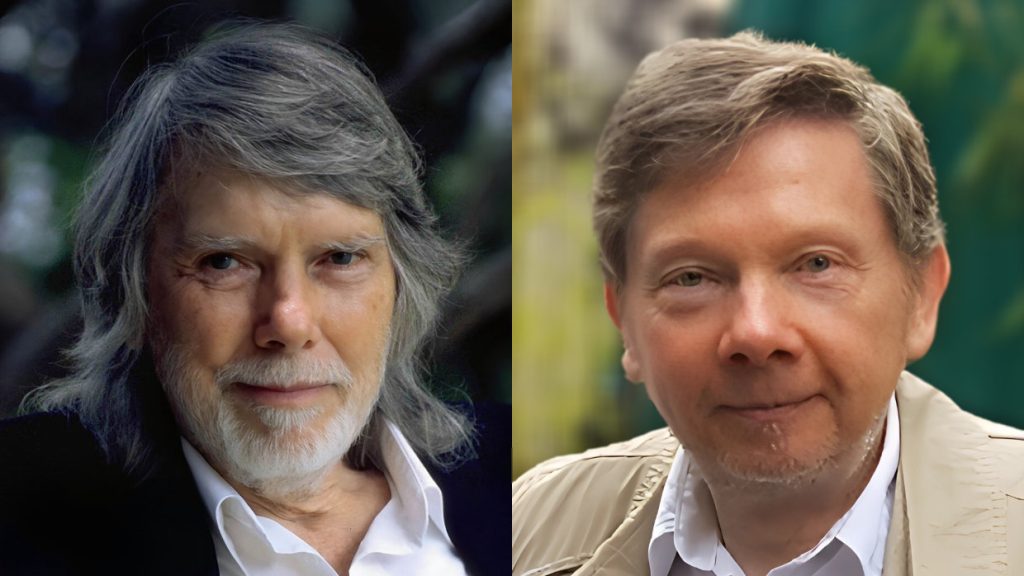
Barry Long (L) and Eckhart Tolle (R)
Tolle’s unacknowledged influences go beyond the Fourth Way however. Most notably, Tolle shares many remarkable similarities with the Australian mystic and independent spiritual teacher Barry Long, who passed in 2003. Tolle had a known direct connection to Long, having attended Long’s talks in Highgate, London, in the 1980s, well before his own teaching career began.[20] He reportedly even volunteered to translate Long’s work at the time.[21]
I’ve highlighted many of their commonalities in a recent article, which covers a range of corresponding topics and themes. However, the most blatant commonalities between them, as alluded to earlier, concern Tolle’s emotional “pain-body” concept, and Long’s equivalent “unhappy body,” “emotional body” or “pigmy.” These are essentially the same concepts by different names: each is a psychic body formed of emotional pain that lives inside us, generates emotional turbulence and feeds upon us like a parasite.
As I pointed out a few years ago, Tolle draws influence from both Nicoll and Long for his “pain-body” concept, but aligns most closely with Long’s teachings overall on this idea. [22] Long and Tolle express very specific, closely-matching statements about these energetic “bodies” within us. Consider these comparisons:
Comparisons
| Barry Long On the unhappy/emotional body or pigmy: |
Eckhart Tolle On the emotional pain body: |
| ‘Your “unhappy body” is composed entirely of . . . painful emotional material’, [so] I will refer to it . . . as your emotional body.’[23] | ‘Almost everyone carries . . . an accumulation of old emotional pain which I call “the pain body”’[24] |
| It is a ‘dark body of accumulated emotional energy’[25] | It is ‘a semi-autonomous energy-form . . . made up of emotion’[26] |
| ‘[Your] earliest of emotions did not remain fragmented. In their pain and isolation they drew together inside you.’[27] | ‘The remnants of pain left behind by every strong negative emotion . . . join together . . . in the very cells of your body.’[28] |
| It ‘lives in each one of us’[29] | It ‘lives within most human beings’[30] |
| ‘By the time your “unhappy body” matures, you are emotionally hooked — addicted to . . . emotional pain or unhappiness.’[31] | ‘Any emotionally painful experience can be used as food by the pain-body. . . . The pain-body is an addiction to unhappiness.’[32] |
| It’s ‘a cunningly intelligent entity’[33] | It’s ‘an entity . . . [with] primitive intelligence, not unlike a cunning animal’[34] |
| ‘Is the living past in you’[35] | ‘It is the living past in you’[36] |
| ‘A parasite’[37] | ‘A psychic parasite’[38] |
| ‘Does not want to be found out’[39] | ‘Afraid of being found out’[40] |
| ‘Does not want to die’ | ‘Wants to survive’[41] |
| Has ‘dormant’ and ‘active’ periods[42] | Has ‘dormant and active’ modes[43] |
| ‘Responsible for all your negative moods . . . and unhappiness.’[44] | Any sign of unhappiness in yourself, in whatever form . . . may be the . . . pain-body.[45] |
| ‘Affect[s] . . . parts of the body with aches and pains.’[46] | ‘Creates[s] physical aches and pains in different parts of the body.’[47] |
Furthermore, these two authors share commonalities on a range of other topics: from being present in the now, taking responsibility for life, the addiction to unhappiness, psychic possession by a false self, the death of the ego/personality, and more. We also see identical, arresting phrases crop up in their work like: “there is no death,” and “this book is about you.”
Despite the many obvious parallels, and Tolle’s past history with Long, Tolle never acknowledges or even mentions Long in his books, which is quite astonishing. The commonalities in their work are so patent that I believe this has to be called plagiarism.
Yet rather than acknowledge Long, Tolle seems to play down and minimise any sense of impact or influence Long had on him when he does speak of him.
By his telling, Tolle had purportedly attained self-realisation already when he encountered Long, whose teachings then helped him to understand his enlightened state “more deeply.”[48] When asked questions about this period of his life, Tolle has occasionally mentioned in passing that he attended Long’s talks and loved his teachings—but he has not, to my knowledge, clearly acknowledged any direct influence Long had on the actual content of his work. [49]
In another interview, which mostly discussed the pain-body, Tolle even seemed to suggest that the pain-body was an idea he came upon independently—a “realisation” gained from “working with people.”[50] But it’s difficult to believe that Tolle came upon a concept essentially identical to Long’s without having been influenced by him—when we know for a fact Long taught an equivalent idea before him, and, furthermore, that Tolle was exposed to Long’s teachings some 15 years before he published anything himself.
It is clear enough to me that Tolle is not telling the whole story here.
So … what does this mean?
This brings us back to the premise of this article: some of Tolle’s biggest influences are not, I believe, ancient wisdom—and perhaps not even “the one true source within”, as he has claimed—but other western teachers who came before him. These particular figures never reached the fame and recognition he did—and probably didn’t seek to either—and that’s largely why their influence has gone unnoticed.
I believe I have presented more than enough information to show that Tolle has derived major components of his teaching from the work of Maurice Nicoll and Barry Long. I am not convinced I have unearthed the full extent of this though. This kind of comparative analysis is very time-consuming, and I have shared what I have been able to find so far. But there could very well be more to uncover.
I do not publish these findings to condemn Tolle, or, for that matter, to elevate or eulogize those who influenced him: I simply present this information because I believe it to be true and in the public interest. People can make up their own minds about different spiritual teachers. But whatever we may think of any given teacher, we are better off knowing the background of the ideas they teach. This is especially the case when the ideas gain traction and become incredibly popular.
Tracing the history of ideas that broadly sit within western esotericism, or what we might call “contemporary alternative spirituality,” is not so easy to do though. These are broad categories that can include a diversity of teachings from a multitude of traditions and sources, old and new. And modern expositors, like Tolle, tend to be both eclectic in their influences and inclined towards vague generalisations, muddying the distinctions between the sources they do draw from. Furthermore, these ideas do not often have a widely-recognised lineage like those found in the canons of established religious traditions often do. Nevertheless, despite their vague forms and origins, some of these ideas have come to permeate the spiritual dimensions of our culture.
So … why does this matter?
Not knowing the history of the spiritual ideas surrounding us greatly limits us. It denies us the opportunity to explore, consider, compare and contrast the different sources who discuss the ideas, weigh the varied and differing perspectives that have been taken, understand how the ideas have been developed and changed—and thus better understand and evaluate various contributions and interpretations. Our ignorance also leaves us with a vastly incomplete picture of our culture, veiling what can be a rich and interesting history.
Right now, whether intentional or not, Tolle comes across as the originator—or perhaps as some uniquely gifted modern interpreter—of certain spiritual concepts. But I don’t think that’s a very accurate view, his talents as a writer and orator notwithstanding.
I do not believe Tolle is, for the most part, deciphering timeless spiritual knowledge and making it understandable: rather, he’s synthesising the work of other contemporaries who, to some extent, already tried that. I’m not suggesting Tolle’s work is just a verbatim copy of any one given source, but I do believe major threads in his teaching tapestry have been derived from the work of other modern authors and woven together into a composite with other threads. Yet because these sources are not acknowledged by Tolle, the result is that their contributing “threads” go unnoticed, and all the credit accrues to Tolle.
And this means that, intentionally or not, Tolle is basking in a glow not entirely of his own making. He’s been called “an otherworldly genius”—this was emblazoned on one of his book covers.[51] And he’s clearly adored by millions. Every year, London’s Watkins Magazine, one of the oldest and largest “spiritual but not religious” publications in the West, ranks him one of the most spiritually influential living people in the world, usually just behind Pope and Dalai Lama—though in the 2011 inaugural “Spiritual 100” listing he was actually ranked first.
As well as prestige, Tolle has also accrued vast wealth from his teaching career. Receiving his teachings in person can be a very expensive affair indeed.
To be clear, I do not expect any teacher of spiritual or esoteric knowledge to be perfect. I also accept that many people may have benefited from Tolle’s work. But many key ideas in his teaching owe a great deal to the work and efforts of others, and people have a right know about this. If those sources are not acknowledged, then all the focus—and, in many cases, money—is directed to Tolle instead. I do not believe that is right. And I do believe the truth matters here whether one sees value in any of these teachings or not.
I also do not put any stock in notions that spiritual practice can be divorced from ethics—although in today’s consumer-orientated wellness and mind-body-spirit “industries,” this increasingly seems to be the case. I agree with the view that we miss the point if spiritual practice is just treated as a means to “feel good” about ourselves, rather than actually be good—or at least try to be—in how we conduct ourselves, contribute to the world, and treat others.
Ultimately, I believe that Tolle ought to have clearly acknowledged his sources, as that is simply the right and ethical thing to do. Writers are widely expected to acknowledge the fact when they use another’s words or ideas in their work. That acknowledgment can vary in its formality depending on the medium or genre, but it should be there in some form. This widely-recognised ethical standard applies to writers of all persuasions, whether students or professionals such as journalists, scholars, scientists, playwrights—or published authors like Tolle.
To be more direct: plagiarism is an ethical breach in many literary fields, and, as I have mentioned, I believe that Tolle has technically committed plagiarism with Barry Long’s work at the very least.
Do the same standards not apply to Tolle? Is it asking too much to expect these standards to be upheld by a teacher of “spiritual enlightenment?” Should we consider such writing beyond the scope of commonplace ethics? I actually do not think so. If anything, the ethical standards should be even higher I think.
Consider this: why is it that we consider it right for writers to give fair acknowledgement to others? Surely because absorbing credit for the contributions of others is not fair or honest. It shows gratitude, humility and, most importantly, integrity to credit others for their ideas. We might agree with those ideas, expand upon them, or even critique them, but we must still acknowledge their source.
I have just mentioned traits of human decency: integrity, humility, honesty etc. These traits run counter to egoism. To give fair acknowledgment is an anti-egotistical act. It sets the right example. So I really do not think it is asking too much to expect this standard from someone professing to guide others to enlightenment by diminishing the ego. Tolle even claims to have no ego.[52]
If my research is valid—and I think it is—then there is a great discrepancy between what Tolle says and what he does.
However, all I can do is outline what I have discovered. The ethical implications are for you, the reader, to ponder. And I do think those implications concern us all, whether we appreciate Eckhart Tolle’s work or not. Because, the fact is, for better or worse, rightly or wrongly, Tolle is the most prominent independent spiritual teacher in our culture. And if we, collectively, disregard ethics when selecting and elevating our spiritual role models, what does that say about us?
And if Tolle disregards them, what does that say about him?
In closing, I am not suggesting Tolle should not teach or comment on spiritual ideas; only that he ought to acknowledge his sources when he does.
Some teachings are best given by example.