All comparative quote slideshows from this site’s articles are gathered below. They juxtapose Eckhart Tolle’s words with those of earlier authors, mainly Maurice Nicoll and Barry Long, and show Tolle similarly expressing corresponding ideas to these authors. Use the forward and back arrows near the top corners of the images to cycle through them, or just swipe if using a mobile device. Some have captions underneath with further information. To browse quotes by category, use the links at the bottom of the page.
Mixed reel
This slideshow, which features on the homepage, compares the words of Eckhart Tolle to similar statements made by Maurice Nicoll and Barry long on a variety of topics. You can also view these comparisons in a table with citations.
“ ‘Self-observation is an act of attention directed inwards—to what is going on in you.’
- Maurice Nicoll (1943)
“‘Monitor your mental-emotional state through self-observation. . . . Direct your attention inwards.’
- Eckhart Tolle (1997)
“ ‘The power of self-observation is an inner sense, rarely used. . . . We are unaware of what we are doing.’
- Maurice Nicoll (1952)
“‘You need to have some power of self-observation, which is another word for awareness.’
- Eckhart Tolle (2008)
“ ‘We have the power of choice internally [by observing our state].’
- Maurice Nicoll (1945)
“ ‘With the seeing [of inner dysfunction] comes the power of choice.’
- Eckhart Tolle (2005)
“ ‘You become responsible . . . when one begins to apply [this Work] to oneself and to the state one is in at any moment.’
- Maurice Nicoll (1945)
“ ‘To end the misery . . . you have to start with yourself and take responsibility for your inner state at any given moment.’
- Eckhart Tolle (2005)
“ ‘By practice you can observe your mood more and more distinctly.’
- Maurice Nicoll (1953)
“ ‘With practice, your power of self-observation, of monitoring your inner state, will become sharpened.’
- Eckhart Tolle (1997)
“ ‘Negative emotions . . . are extremely infectious.’
- Maurice Nicoll (1953)
“ ‘The negative mental-emotional force fields of others . . . are highly contagious.’
- Eckhart Tolle (1997)
“ ‘A person who is thoroughly negative . . . can infect people in a much more dangerous fashion than bacteria or viruses.’
- Maurice Nicoll (1950)
“ ‘Any negative inner state is contagious: Unhappiness spreads more easily than a physical disease.’
- Eckhart Tolle (1997)
“ ‘Your “unhappy body” is composed entirely of . . . painful emotional material, [so] I will refer to it . . . as your emotional body.’
- Barry Long (1994)
“ ‘Almost everyone carries . . . an accumulation of old emotional pain which I call “the pain body.”’
- Eckhart Tolle (2005)
“ ‘By the time your “unhappy body” matures, you are emotionally hooked — addicted to . . . emotional pain or unhappiness.’
- Barry Long (1994)
“ ‘Any emotionally painful experience can be used as food by the pain-body. . . . The pain-body is an addiction to unhappiness.’
- Eckhart Tolle (2005)
“ ‘The emotional body is a living thing, living off you like a parasite.’
- Barry Long (1994)
“ ‘The pain-body [is] a parasite that can live inside you for years, feed[ing] on your energy.’
- Eckhart Tolle (1997)
“ It’s ‘a cunningly intelligent entity.’
- Barry Long (1987)
“ It’s ‘an entity . . . [with] primitive intelligence, not unlike a cunning animal.’
- Eckhart Tolle (2005)
“ It ‘is the living past in you.’
- Barry Long (1987)
“‘It is the living past in you.’
- Eckhart Tolle (1997)
“ ‘When two people marry they do not only marry their physical bodies but they marry their Time-bodies.’
- Maurice Nicoll (1949)
“ ‘You don’t just marry your wife or husband, you also marry her or his pain-body.’
- Eckhart Tolle (2005)
“ ‘By true self-observation we let a ray of light into ourselves. . . . Not . . . physical light but the light of Consciousness.’
- Maurice Nicoll (1945)
“ ‘Just observe the emotion. . . . Attention is like a beam of light – the focused power of your consciousness.’
- Eckhart Tolle (1997)
“ ‘By the method of self-observation . . . [we] bring this not yet known side of ourselves into the light of consciousness.’
- Maurice Nicoll (1946)
“ ‘You are the watcher, the observing presence. If you practice this, all that is unconscious in you will be brought into the light of consciousness.’
- Eckhart Tolle (1997)
“ ‘Get to work and make it conscious by means of candid self-observation.’
- Maurice Nicoll (1952)
“ ‘Make it conscious. Observe the many ways in which unease, discontent, and tension arise within you.’
- Eckhart Tolle (1997)
“ ‘Focus your inner attention on the feeling in the area of your navel, and hold it.’
- Barry Long (1994)
“ ‘Focus attention on the feeling inside you. Know that it is the pain-body.’
- Eckhart Tolle (1997)
“ ‘You have to be able to feel the presence of your emotional body within you. If you cannot feel it, you can’t begin to deal with it.’
- Barry Long (1994)
“ ‘You need to be present enough to be able to watch the pain-body directly and feel its energy. It then cannot control your thinking.’
- Eckhart Tolle (1997)
“ ‘He’ll fight furiously to keep you from putting the spotlight of intelligence, your attention, on him.’
- Barry Long (1987)
“ ‘This means putting the spotlight of your attention on it. . . . Feel the strong energy charge behind it.’
- Eckhart Tolle (1997)
“ ‘So it will try to distract you, and it usually succeeds. One way it does this is by affecting other parts of the body with aches and pains. These are not lasting.’
- Barry Long (1994)
“ ‘The pain-body will . . . try to trick you into identifying with it again. . . . At this stage, it may also create physical aches and pains in different parts of the body, but they won't last.’
- Eckhart Tolle (1997)
“ ‘It will try to throw you off, like the momentum of a spinning disc. Stay with it.’
- Barry Long (1994)
“ ‘It has a certain momentum, just like a spinning wheel that will keep turning for a while.’
- Eckhart Tolle (1997)
“ ‘Nothing can change in us unless it is brought into the light of self-observation—that is, into the light of consciousness.’
- Maurice Nicoll (1943)
“ ‘If you don’t bring the light of your consciousness into the [emotional] pain, you will be forced to relive it again and again.’
- Eckhart Tolle (1997)
“ ‘There is only one thing in your life you can be sure of. That one thing is this moment, now.’
- Barry Long (1996)
“ ‘You discover that there is only ever this moment. . . . Your entire life unfolds in this constant Now.’
- Eckhart Tolle (2005)
“ ‘You realise this now and in every succeeding moment, which is the eternal now. . . . The Spirit is now. Life is now.’
- Barry Long (1987)
“ ‘The eternal present is the space within which your whole life unfolds, the one factor that remains constant. Life now.’
- Eckhart Tolle (1997)
“ ‘What’s the problem, now? There is no problem, is there? Isn’t it extraordinary?’
- Barry Long (1995)
“ ‘Narrow your life down to this moment. . . . Do you have a problem now?’
- Eckhart Tolle (1997)
“ ‘The diagram of the Cross . . . represents a single moment in a man’s life. In this single moment the vertical line is cut across by the horizontal line of Time. . . . The point of intersection of the vertical with the horizontal line is now.’
- Maurice Nicoll (1942)
“ ‘There’s the vertical dimension and the horizontal dimension. One could even say that the cross . . . symbolizes that also. . . . Most people only know the horizontal dimension, unaware of the vertical dimension which is . . . the present moment.’
- Eckhart Tolle (2017)
“ ‘It is only this feeling of the existence and meaning of the direction represented by the vertical line that gives a man a sense of now.’
- Maurice Nicoll (1942)
“ ‘And so you enter the vertical dimension by being—becoming present, by bringing your attention into the now.’
- Eckhart Tolle (2008)
“ ‘[Real] I dwells in now, and not in passing-time.’
- Maurice Nicoll (1952)
“ ‘It is only now that you are truly yourself.’
- Eckhart Tolle (1997)
“ ‘Personality is formed in Time, and belongs to Time.’
- Maurice Nicoll (1942)
“ ‘The “you” that has a past and a future [is] the personality.’
- Eckhart Tolle (1997)
“ ‘The Personality . . . is not you . . . but it calls itself I . . . and you say I to it.’
- Maurice Nicoll (1946)
“ ‘What you usually refer to when you say “I” is not who you are.’
- Eckhart Tolle (2005)
“ ‘This imaginary oneself. . . . formed by ourselves and by the environmental influences of our upbringing. . . . is . . . called the False Personality, which is formed in the preparatory period of life.’
- Maurice Nicoll (1942)
“ ‘As you grow up, you form a mental image of who you are, based on your personal and cultural conditioning. We may call this phantom self the ego. . . . a false self.’
- Eckhart Tolle (1997)
“ ‘This accursed artificial thing “oneself” . . . causes so much trouble and . . . possesses us without our seeing it.’
- Maurice Nicoll (1952)
“ ‘It's almost as if you were possessed without knowing it, and so you take the possessing entity to be yourself.’
- Eckhart Tolle (1997)
“ ‘In adulthood the possessing psychic entity is well and truly entrenched — as the unhappy, contradictory personality itself.’
- Barry Long (1994)
“ ‘Most people are so completely identified . . . that we may describe them as being possessed. . . . You take the thinker to be who you are. This is the egoic mind.’
- Eckhart Tolle (2005)
“ ‘You have to die to the old man in you. You must die to the past. You must die to this thinker every moment.’
- Barry Long (1995)
“ ‘Die to the past every moment, and let the light of your presence shine away the heavy, time-bound self you thought of as “you.”’
- Eckhart Tolle (1997)
“ ‘You cannot tell yet what you are save by seeing what you are not and getting gradually . . . away from this great fiction.’
- Maurice Nicoll (1945)
“ ‘In the seeing of who you are not [the illusory self], the reality of who you are emerges by itself.’
- Eckhart Tolle (2005)
“ ‘As you dismantle the personality . . . you will start to feel some disintegration of yourself. . . . Know that it’s your personality you’re losing, not your [true] identity. Nothing you [truly] are or have will disappear.’
- Barry Long (1994)
“ ‘Your radiant true nature remains [in death], but not the personality. In any case, whatever is real or of true value in your personality is your true nature shining through. This is never lost. Nothing that is of value, nothing that is real, is ever lost.’
- Eckhart Tolle (1997)
“ ‘I die now — not in agony, not in pain, but in conscious life, dying to everything except what is. And in dying daily to my unhappiness, dying for life, I finally realise the incredible truth: There is no death. All that dies is my fear of dying. Only fear dies.’
- Barry Long (1994)
“ ‘The acceptance of suffering is a journey into death. Facing deep pain, allowing it to be, taking your attention into it, is to enter death consciously. When you have died this death, you realize that there is no death – and there is nothing to fear. Only the ego dies.’
- Eckhart Tolle (1997)
“ ‘Essence is the indestructible part of us.’
- Maurice Nicoll (1944)
“ ‘I know that the essence of who I am . . . is indestructible.’
- Eckhart Tolle (2008)
“ ‘Real inner change is a development of essence . . . the most real and the deepest part of you.’
- Maurice Nicoll (1943)
“ ‘Discover and live from your true essence—what I sometimes refer to as the “Deep I.”’
- Eckhart Tolle (2021)
“ ‘Now I’m going to introduce you to some finer energies. These energies are of your true body behind the flesh and blood.’
- Barry Long (1995)
“ ‘What I call the “inner body” isn't really the body anymore but life energy, the bridge between form and formlessness.’
- Eckhart Tolle (2005)
“ ‘We’re going to go around the body with our attention so we can bring more consciousness into it.’
- Barry Long (1995)
“ ‘The more consciousness you direct into the inner body, the higher its vibrational frequency becomes.’
- Eckhart Tolle (2005)
“ ‘Can you feel your body as a whole? The whole thing is tingling. The whole body. I’m asking you all if you can feel this. Hold the feeling of the whole body from within. It can be done.’
- Barry Long (1995)
“ ‘Can you feel your body from within, so to speak? Sense briefly specific parts of your body. Feel your hands, then your arms feet, and legs. . . . Then become aware again of the inner body as a whole.’
- Eckhart Tolle (1997)
“ ‘“Why beholdest thou the mote that is in thy brother’s eye but considerest not the beam that is in thine own eye?”. . . This is a pretty good example of what the Work says about observing yourself instead of finding fault with everyone else.’
- Maurice Nicoll (1950)
“ ‘The egoic compulsive habit of faultfinding and complaining about others. Jesus referred to it when he said, “Why do you see the speck that is in your brother’s eye, but do not notice the log that is in your own eye?”’
- Eckhart Tolle (2005)
“ ‘The faults we dislike most in others are usually those that we display ourselves without being conscious of them.’
- Maurice Nicoll (1951)
“ ‘The particular egoic patterns that you react to most strongly in others . . . tend to be the same . . . that are also in you, but that you are unable or unwilling to detect.’
- Eckhart Tolle (2005)
“ ‘Everything that you are so critical of in others is expressing itself in you.’
- Maurice Nicoll (1946)
“ ‘Anything that you resent and strongly react to in another is also in you.’
- Eckhart Tolle (2005)
“ ‘Anyone able to read this book right through will have developed to a certain stage of consciousness. To a less developed person it would seem meaningless.’
- Barry Long (1994)
“ ‘This book . . . will change your state of consciousness or it will be meaningless. It can only awaken those who are ready.’
- Eckhart Tolle (2005)
Spiritual Psychology
These quote images come from articles comparing how Tolle and earlier authors similarly discuss aspects of the psyche, such as the personality and essence.
Our “essence” is our deepest self, the real/true aspect of who we are, Nicoll and Tolle convey.
Read the article this image was featured in here.
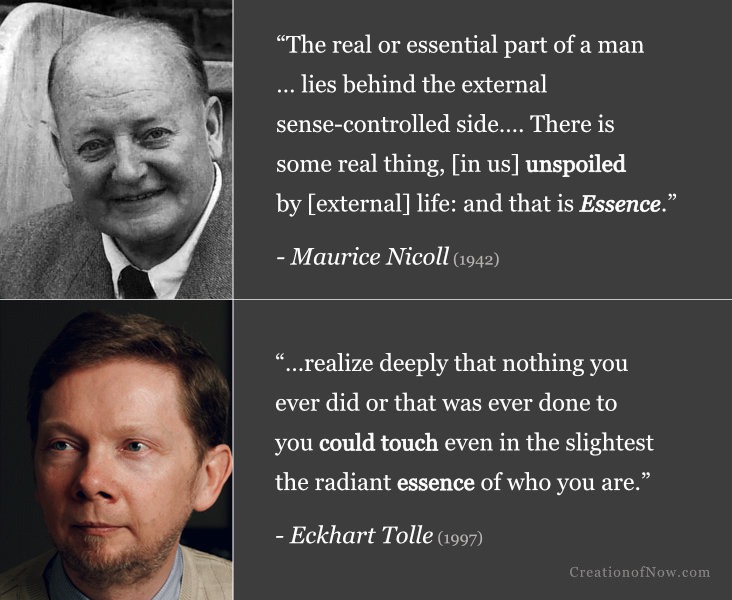
Essence remains untouched or unspoiled by what happens externally, they suggest.
Read the article this image was featured in here.
People identify more with their personality/psychological form and neglect essence, they say.
Read the article this image was featured in here.
What we consider our personality or refer to as “I” is not who we really are, they explain.
Read the article this image was featured in here.
Our personality, shaped by exterior customs or conditioning, isn’t really us, the authors say.
Read the article this image was featured in here.
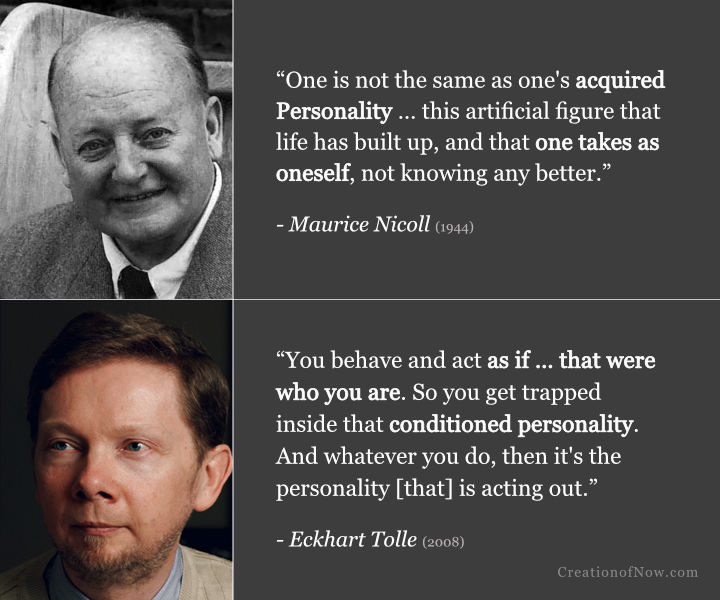
People typically mistake their personality for who they really are, Nicoll and Tolle suggest.
Read the article this image was featured in here.
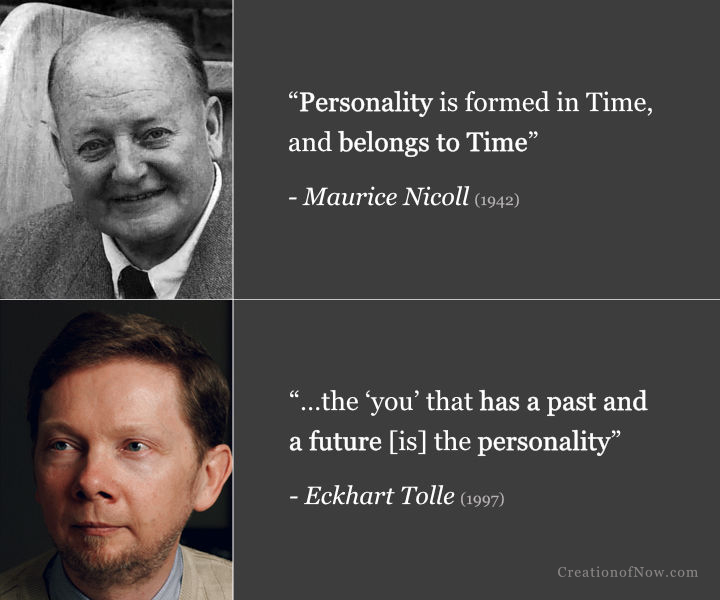
Nicoll and Tolle both characterise the personality as time-limited.
Read the article this image was featured in here.
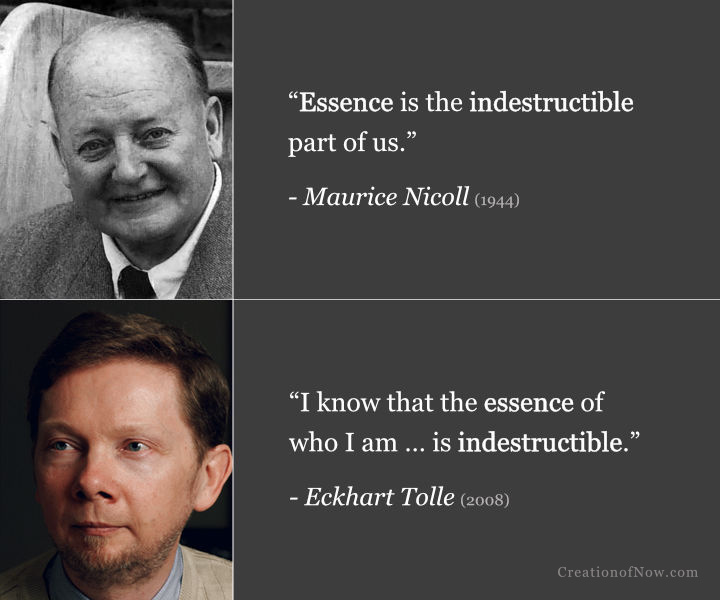
They describe our “essence” as eternal/timeless and “indestructible.”
Read the article this image was featured in here.
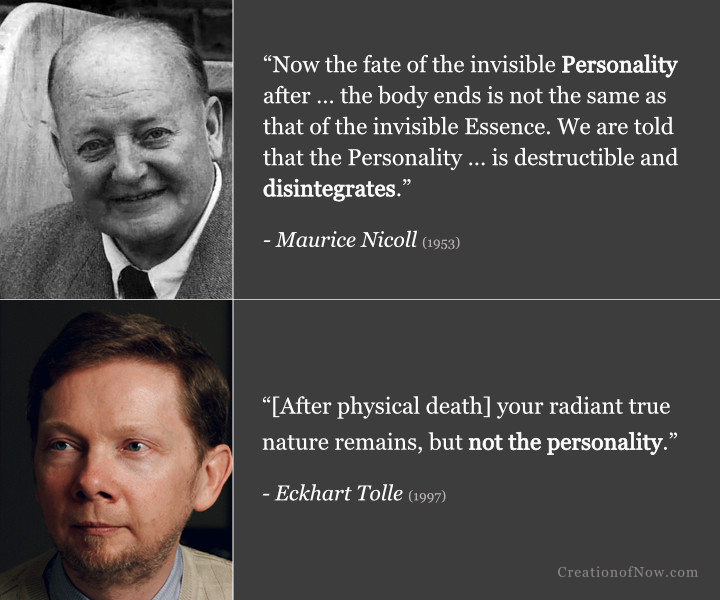
Our essence or true nature continues after death, the authors say, but the personality perishes.
Read the article this image was featured in here.
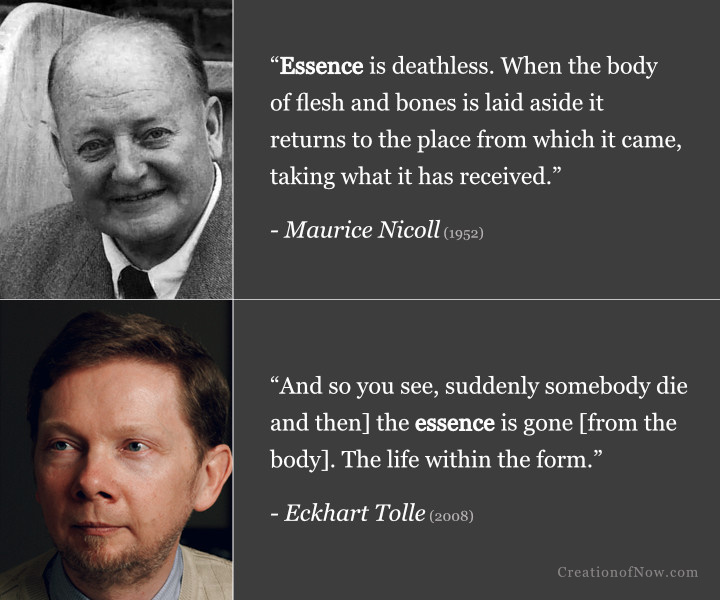
Essence isn’t bound to the body; it departs it at death and continues on, they suggest.
Read the article this image was featured in here.
Unlike the personality, one’s essence or true nature cannot be lost or stripped away, they say.
Read the article this image was featured in here.
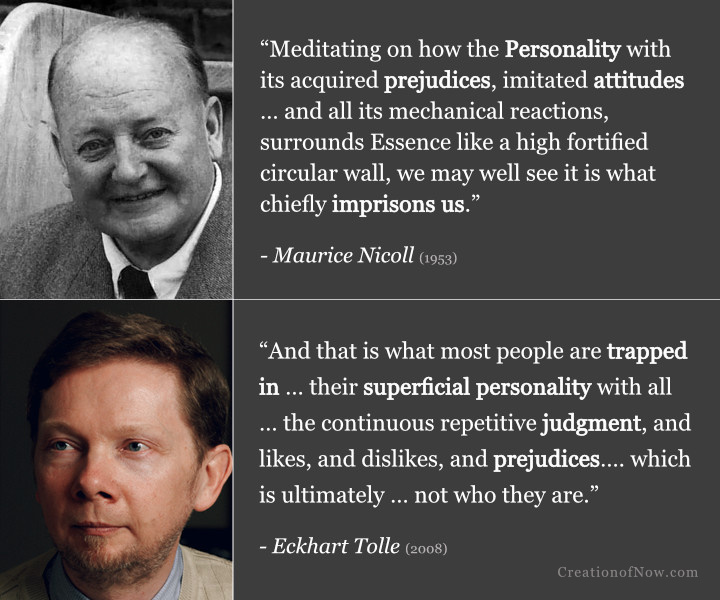
Psychologically we’re typically trapped or imprisoned in the personality with all its fixed ways and prejudices, the authors convey.
Read the article this image was featured in here.
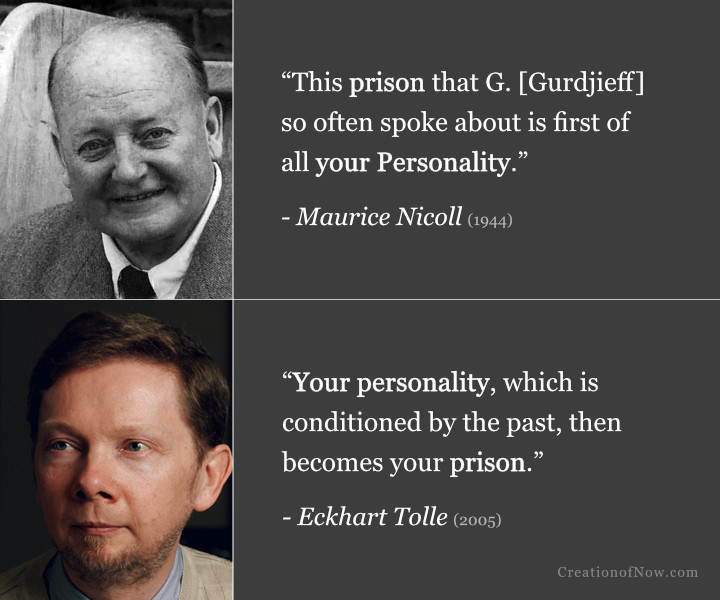
Both describe “your personality” as a “prison” as Gurdjieff did (although, unlike Nicoll, Tolle never directly mentions Gurdjieff or the Fourth Way in his writing).
Read the article this image was featured in here.
In a higher state of consciousness we feel something beyond time and the personality, Nicoll and Tolle convey.
Read the article this image was featured in here.
This state is found by being more conscious in the now, the authors insist. One momentarily transcends time and the personality and experiences their true self, which is eternal or timeless.
Read the article this image was featured in here.
It’s in the now, the state of being conscious in the present, where our real self is found, they maintain.
Read the article this image was featured in here.
The cross can represent the meeting of a “vertical” and a “horizontal” dimension, Nicoll and Tolle both say. Tolle acknowledges others have used this interpretation before, but gives no names.
Read the article this image was featured in here.
The vertical, the authors suggest, exists beyond the horizontal line of the cross depicting time. It’s only encountered in the present moment or now.
Read the article this image was featured in here.
The vertical pertains to our state of being, they convey, while the horizontal pertains to the events of our life in time.
Read the article this image was featured in here.
We only feel or enter the vertical by being conscious in the now, Nicoll and Tolle convey.
Read the article this image was featured in here.
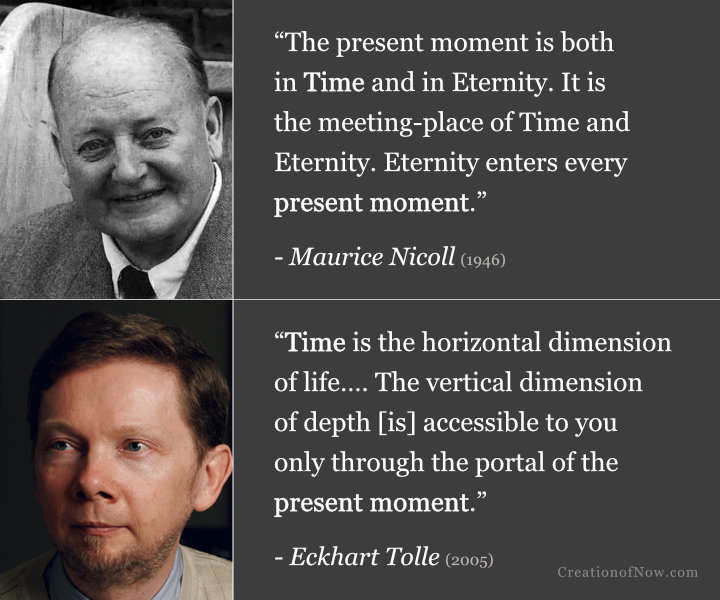
The present moment is the entry point for the vertical dimension that’s beyond time, the authors tell us.
Read the article this image was featured in here.
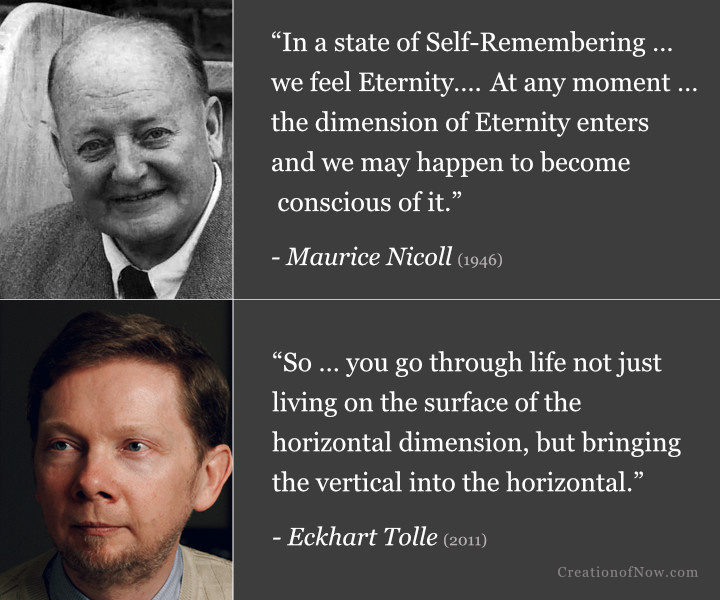
We can consciously perceive eternity/the vertical dimension coming into the horizontal flow of time, we are told.
Read the article this image was featured in here.
We must consciously feel/focus on the now to experience the vertical dimension of eternity, they suggest.
Read the article this image was featured in here.
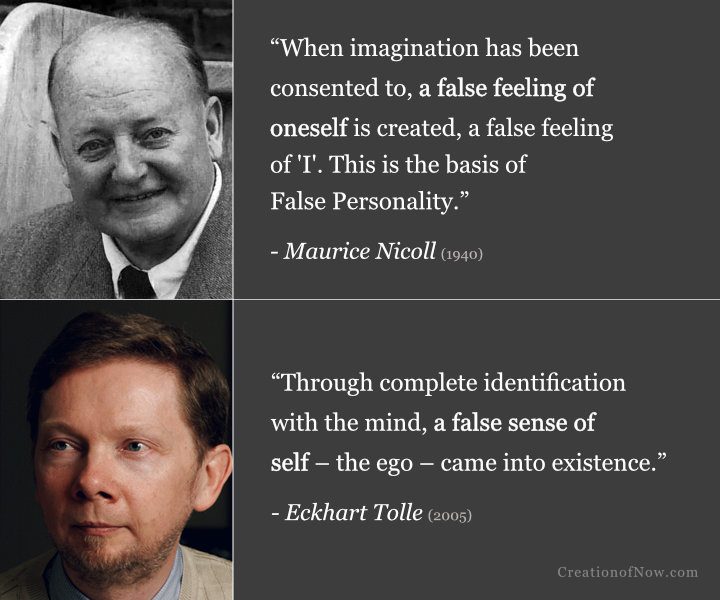
Our false self comes about through identifying with the mind or imagination, and gives us a false feeling/sense of who we are, Nicoll and Tolle convey.
Read the article this image was featured in here.
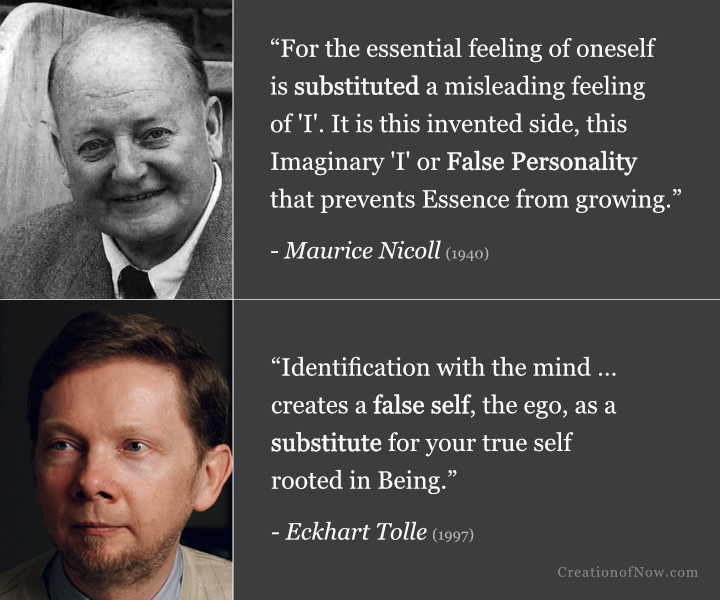
The false self/personality acts as a psychological substitute for our true or essential self, the authors say.
Read the article this image was featured in here.
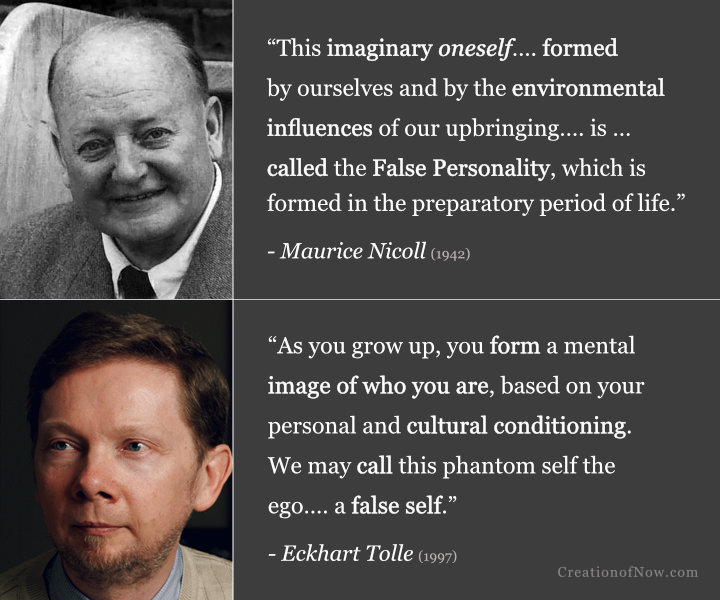
The false self/personality is formed by the environmental/cultural influences/conditioning of our upbringing and the imaginary idea or image we form of ourselves, the authors convey.
Read the article this image was featured in here.
The egoic or imaginary self that rules us is a “mental construct” or “composed of imagination” Tolle and Nicoll respectively tell us.
Read the article this image was featured in here.
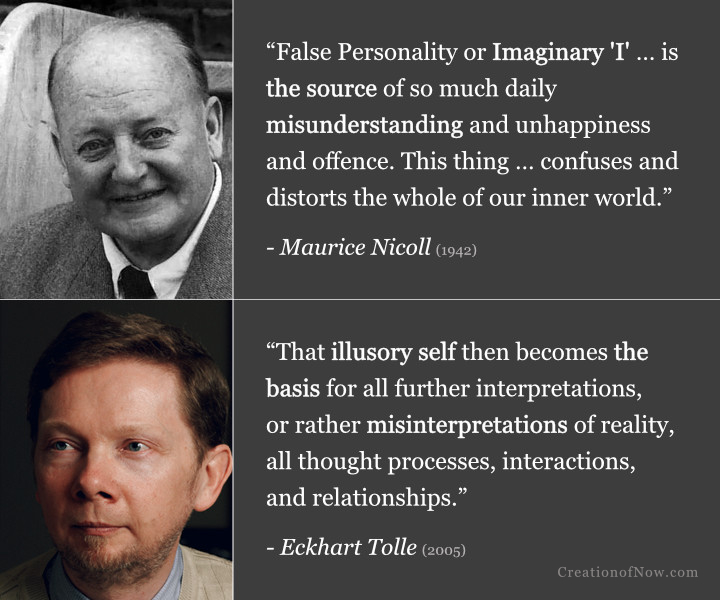
Our imaginary or illusory “I” or “self” is the cause of many misunderstandings or misinterpretations, creating confusion inwardly and externally.
Read the article this image was featured in here.
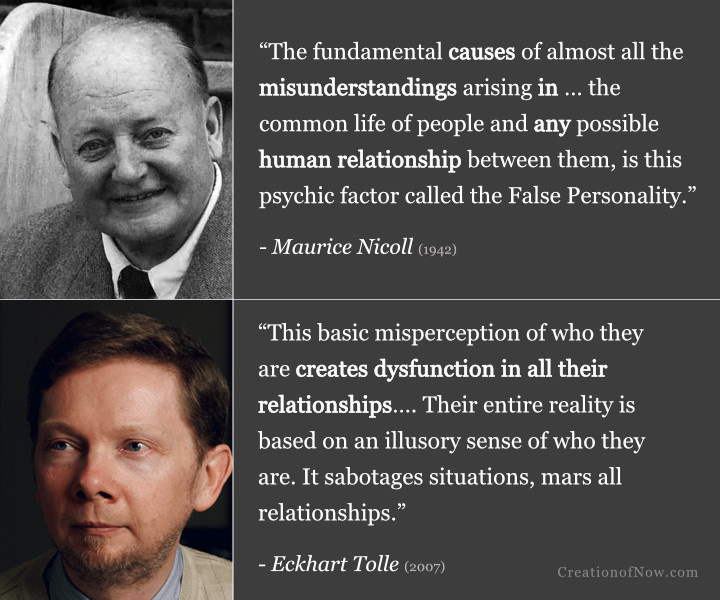
The false self is the source of much of the dysfunction or misunderstandings occurring in human relationships, the authors say.
Read the article this image was featured in here.
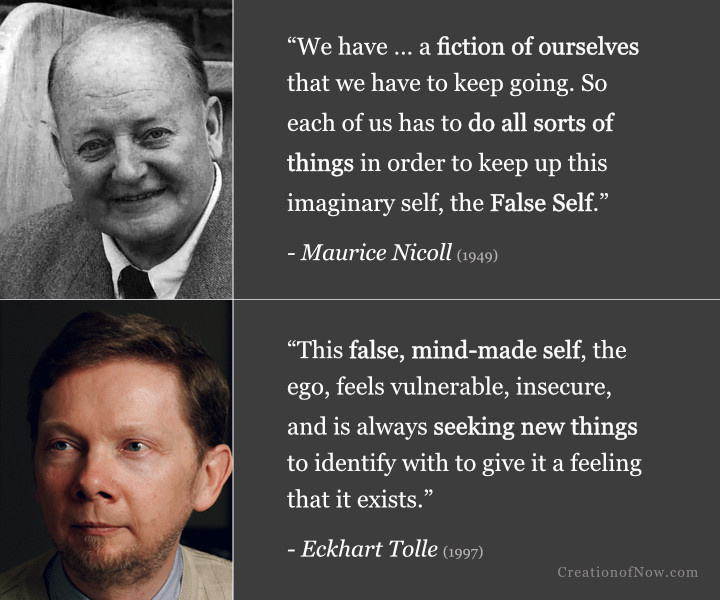
Because the false self is only a fiction/mind-made, we constantly feel compelled to do things to maintain it, we’re told.
Read the article this image was featured in here.
Living through the False Personality/ego creates underlying fear, the authors say, even if it’s hidden. Striving to maintain something unreal brings ongoing anxiety/insecurity about losing it.
Read the article this image was featured in here.
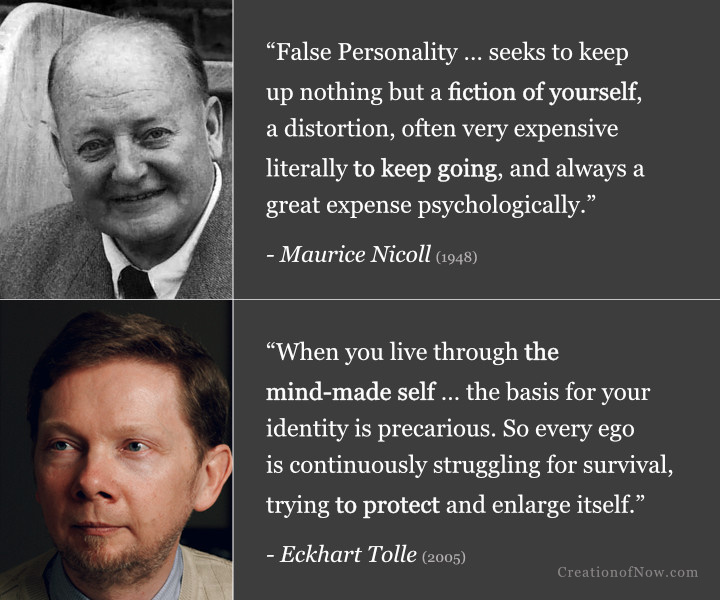
The desire to sustain the ego or false personality creates an unending psychological struggle or expense because one is essentially striving to maintain a fabrication, the authors suggest.
Read the article this image was featured in here.
The illusory or imaginary “I” or identity we cling to, and its fictitious self-image/pictures, will start to dissolve or collapse when brought into the light of consciousness, the authors say.
Read the article this image was featured in here.
We mistake the false self for who we are, the authors say, but when we observe or recognize what’s in us clearly, our illusory/imaginary self begins to dissolve.
Read the article this image was featured in here.
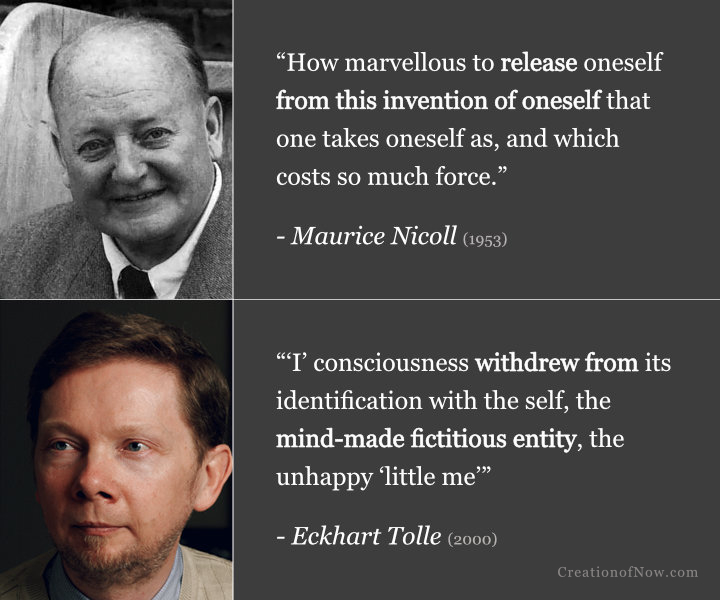
To release oneself or withdraw—psychologically—from one’s identification with the false self is a great relief, the authors suggest.
Read the article this image was featured in here.
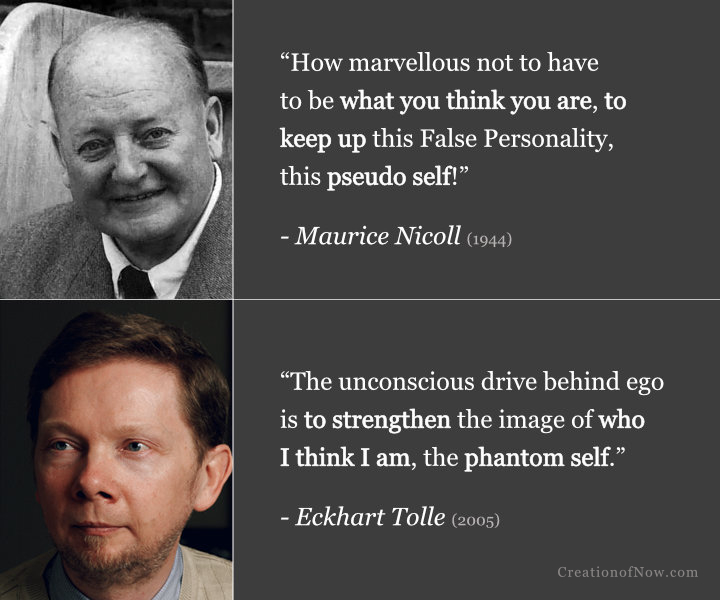
The pseudo self or phantom self wants to fortify itself—the idea or image of who we think we are, Nicoll and Tolle say.
Read the article this image was featured in here.
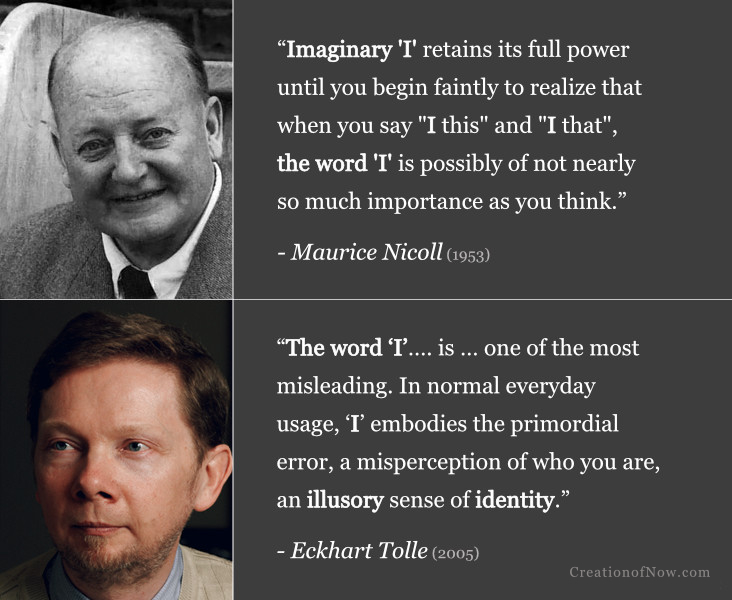
The imaginary/illusory I or identity is at least partly sustained, Nicoll and Tolle suggest, by the erroneous importance or perception we give to “the word ‘I'”
Read the article this image was featured in here.
Nicoll and Tolle both explain that a person can discover the truth of who they are only by gradually identifying what they are not.
Read the article this image was featured in here.
Allowing one’s false sense of self to diminish—and thus become less or nothing in relation to what we thought we were—draws real “I” or Being to us, the authors suggest.
Read the article this image was featured in here.
Self-Observation
These images come from an article series comparing how Nicoll and Tolle present the practice of self-observation.
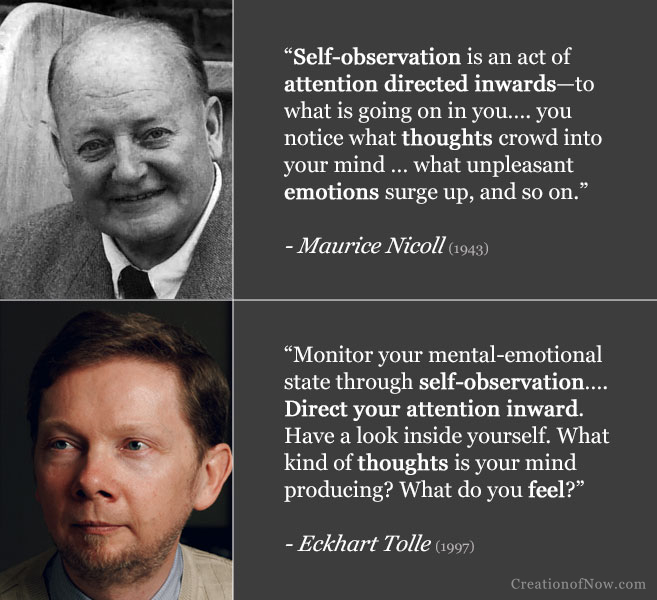
They describe self-observation as a process of directing attention inwards, to observe one’s thoughts, emotions and inner states in a detached way.
Read the article this image was featured in here.
Both authors refer to the “power of self-observation” and indicate this capacity can be developed with practice.
Read the article this image was featured in here.
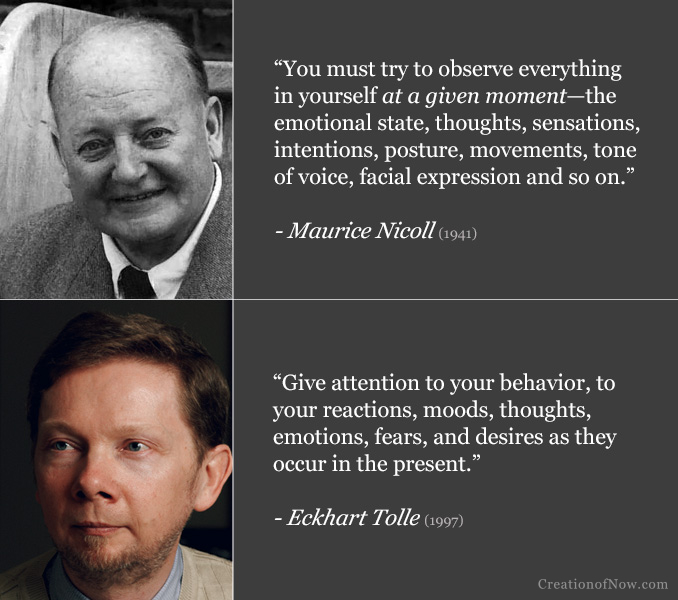
They emphasise the importance of watching many aspects of one’s behaviour and inner states in the present moment.
Read the article this image was featured in here.
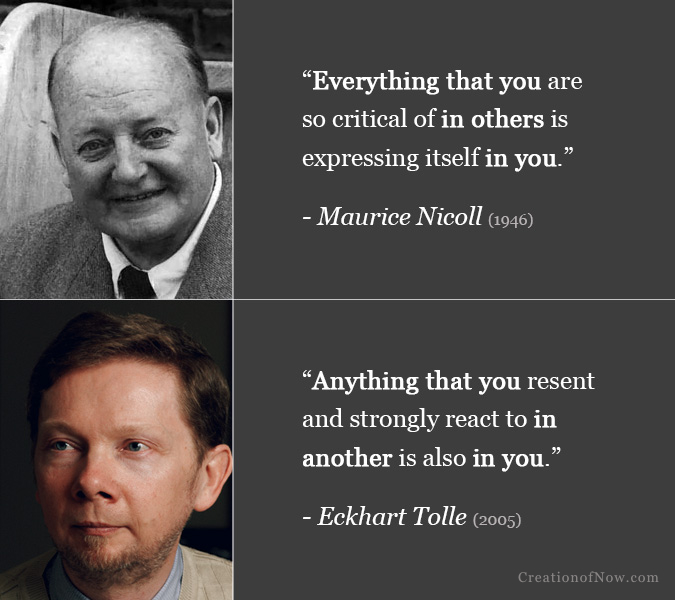
Nicoll and Tolle both state, in very similar terms, that those things we greatly criticise or resent in others are also present within us.
Read the article this image was featured in here.
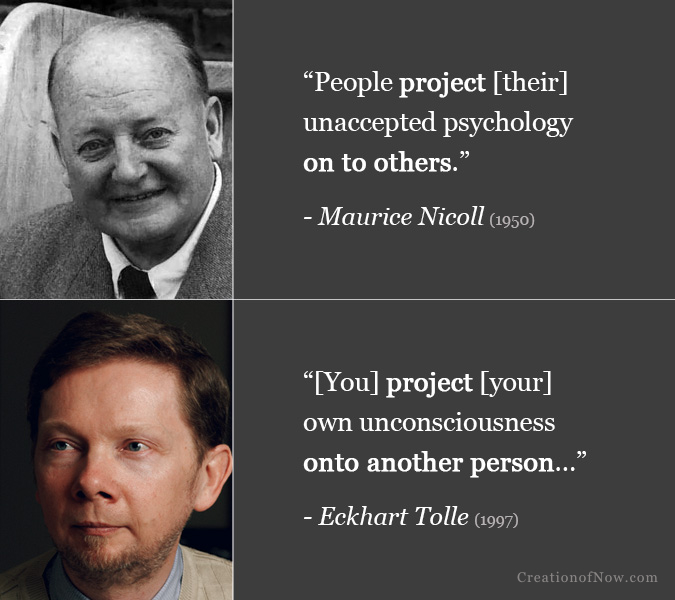
Nicoll, who was close to Jung, brought the idea of psychological projection into self-observation practice. Tolle continues in this vein.
Read the article this image was featured in here.
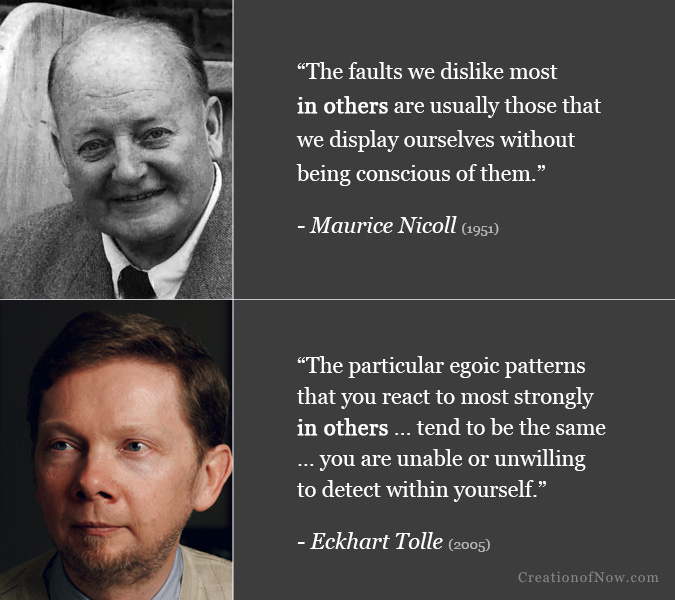
They reiterate the idea that the faults we dislike most in others may exist unrecognized in us.
Read the article this image was featured in here.
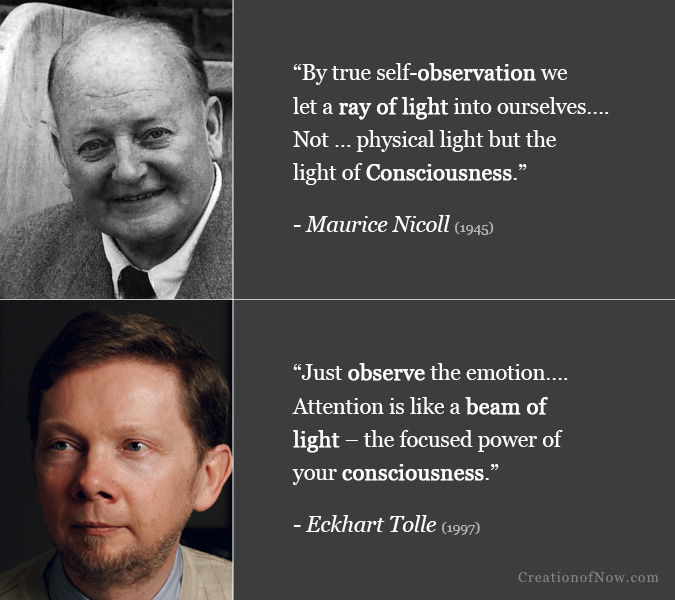
The act of self-observation is said to cast a “ray” or “beam” of light into the psyche. Both Nicoll and Tolle identify this light as consciousness.
Read the article this image was featured in here.
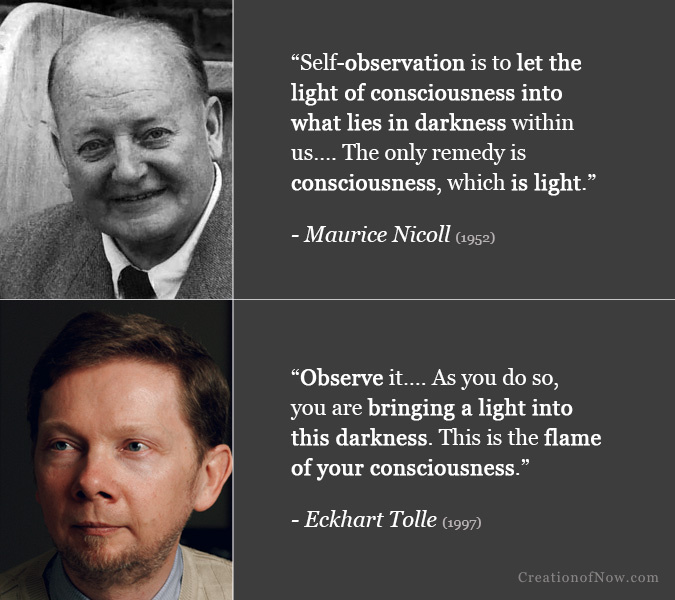
They describe how a person brings the light or flame of consciousness into their inner darkness through self-observation.
Read the article this image was featured in here.
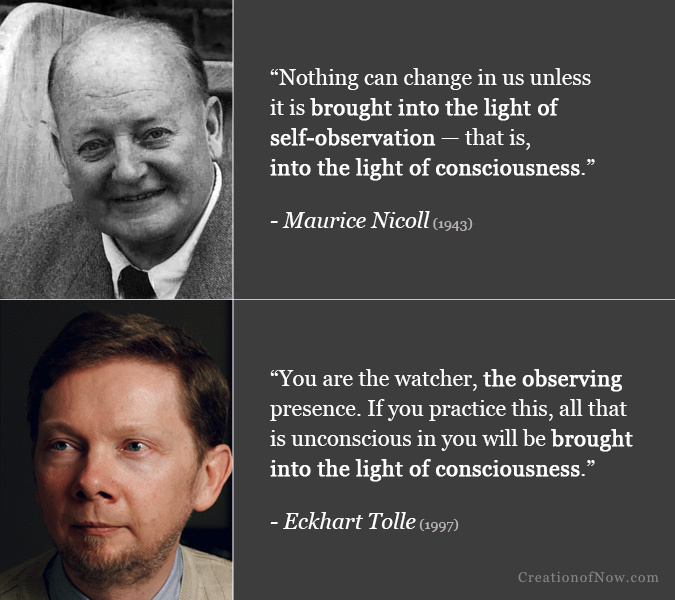
Both Nicoll and Tolle write of bringing what is unconscious into the light of consciousness through self-observation.
Read the article this image was featured in here.
Directing “the light of consciousness” inwards through self-observation is the means for self-transformation in the work of Maurice Nicoll and Eckhart Tolle.
Read the article this image was featured in here.
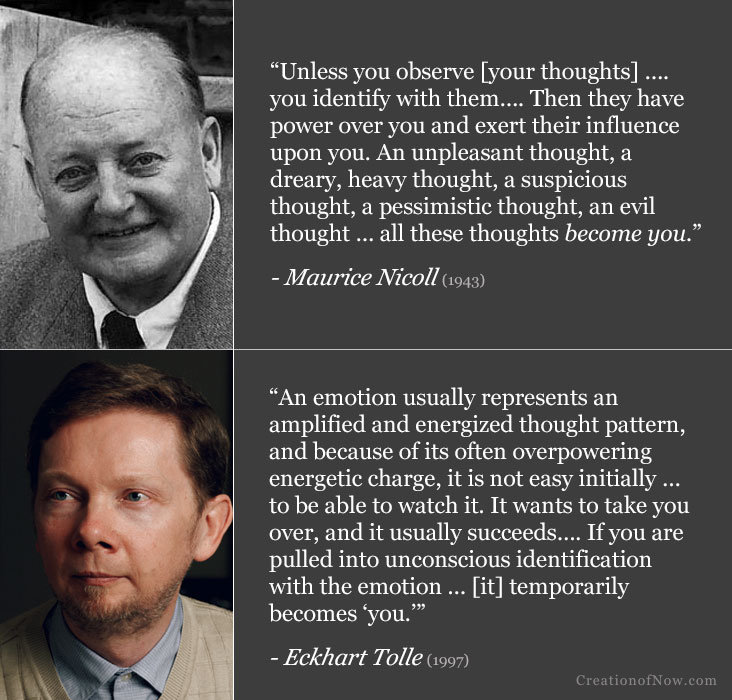
Nicoll and Tolle describe how thoughts and emotions can “become you” through a process called identification.
Read the article this image was featured in here.
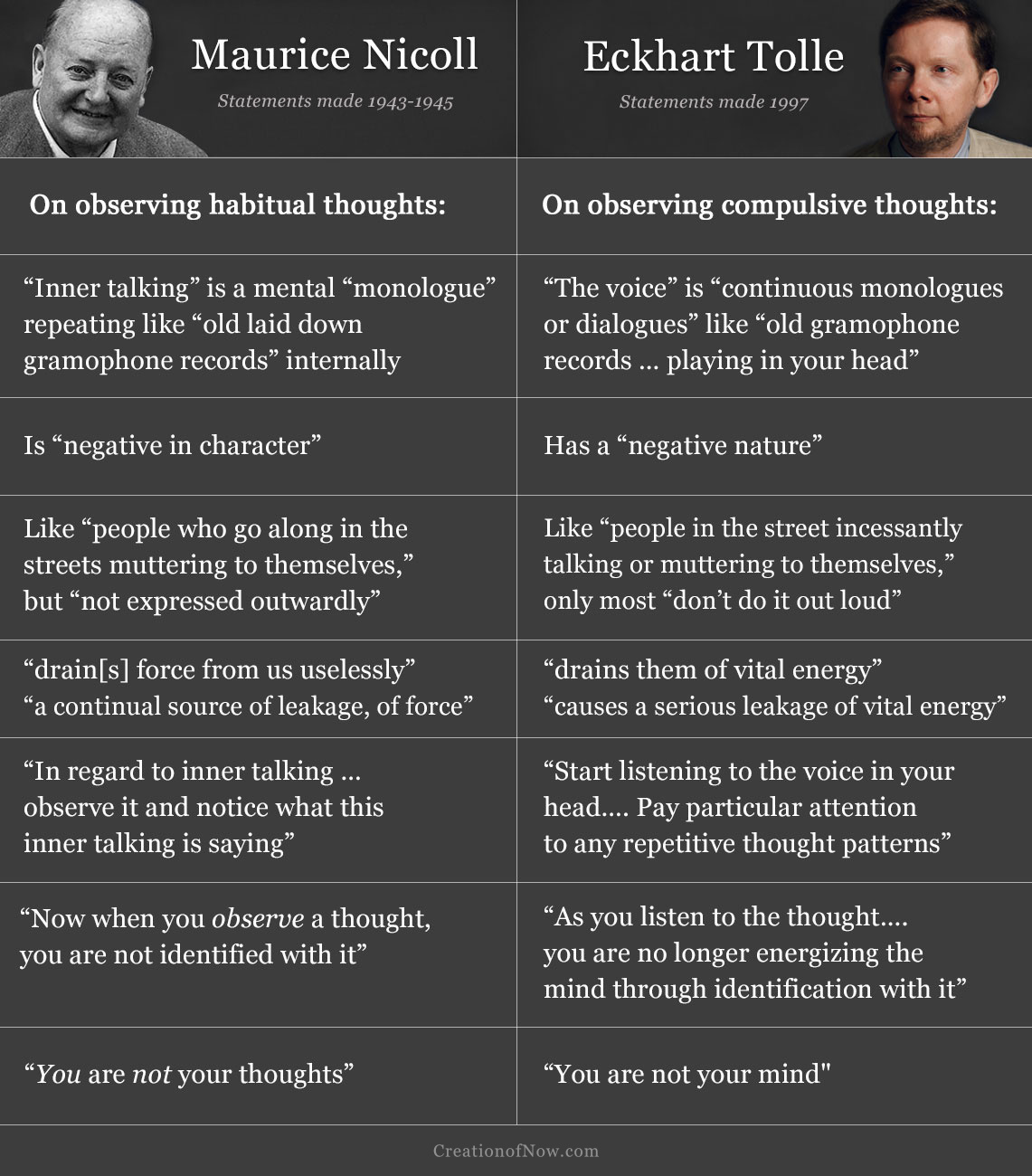
Compulsive thoughts are similarly described as old “gramophone records” playing in one’s head that sound like the monologues of people “muttering to themselves” in the street, only not expressed outwardly. This negative thinking is said to drain energy, according to Nicoll and Tolle, and they encourage readers to observe it in order to stop identifying with it.
Read the article this image was featured in here.
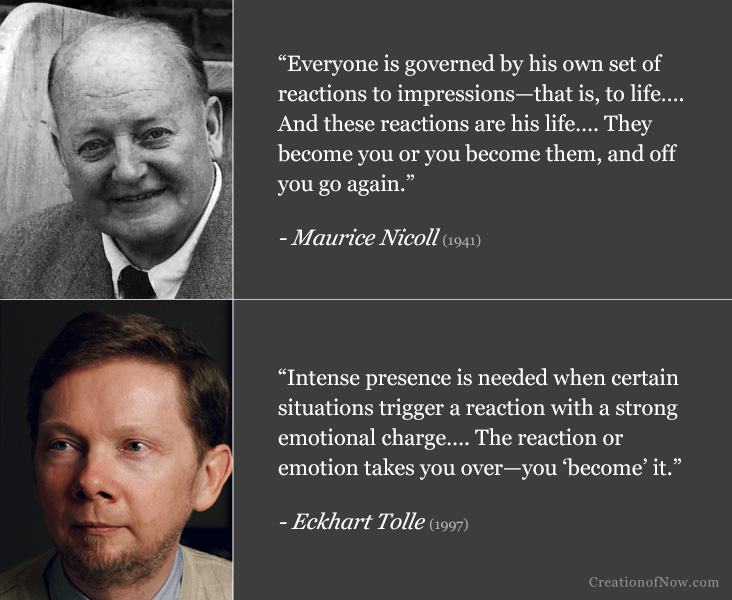
By becoming identified with emotional reactions to life, people “become” their reactions, they explain.
Read the article this image was featured in here.
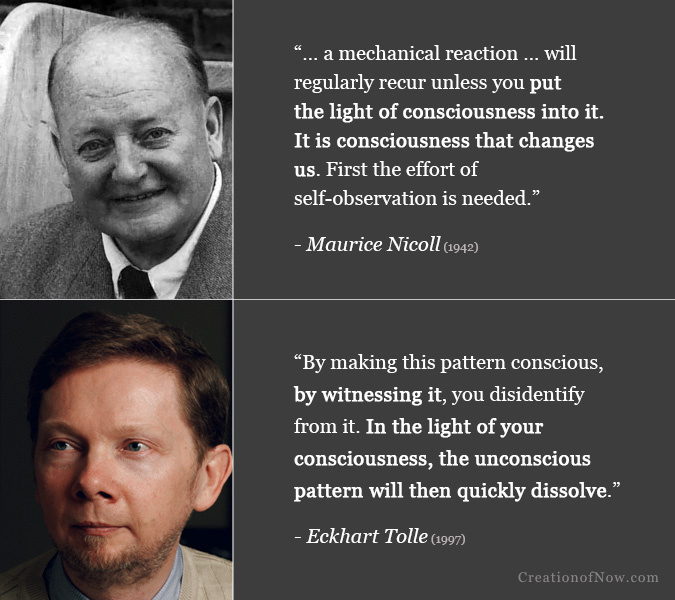
Nicoll and Tolle often describe the transformative effects “the light of consciousness” has on unconscious reactions/patterns. This “light” must be directed within via self-observation.
Read the article this image was featured in here.
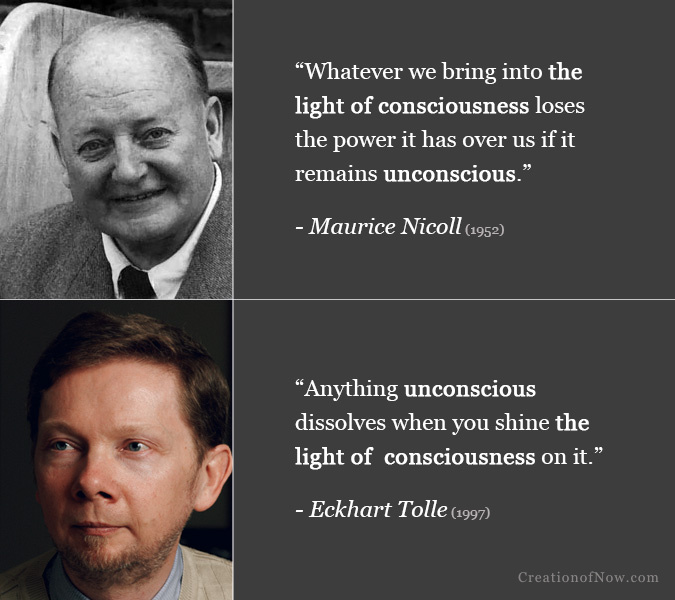
Any unconscious factors are said to lose their power when brought into the light of consciousnesses.
Read the article this image was featured in here.
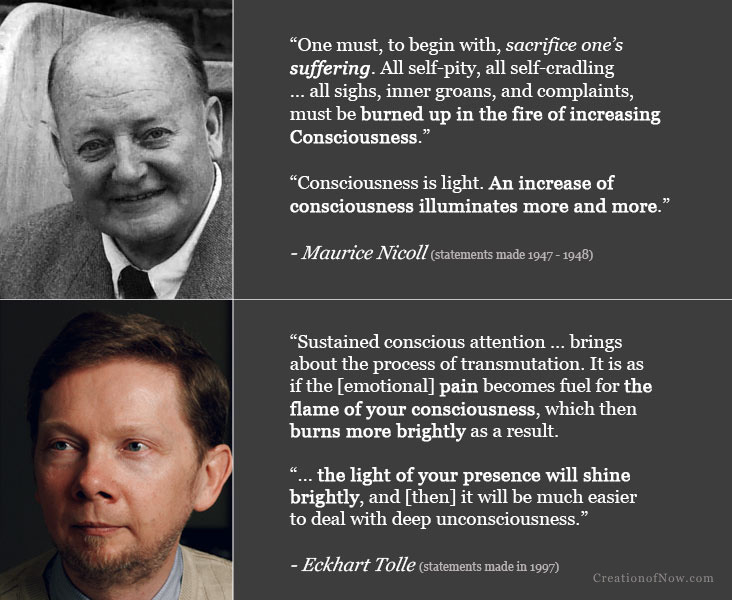
Nicoll and Tolle both state that the fire, flame, or light of consciousness is said to grow brighter as it burns up psychological pain and suffering.
Read the article this image was featured in here.
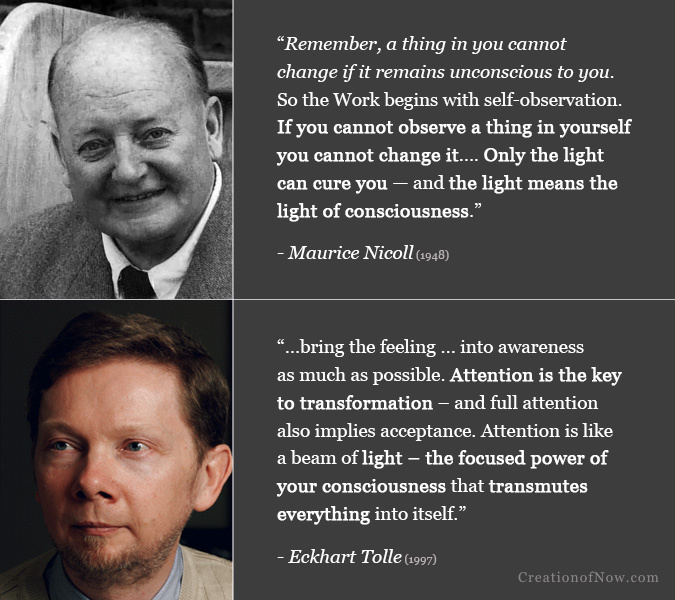
Bringing negative states into the light of consciousness by observation/attention is said to change or transform them.
Read the article this image was featured in here.
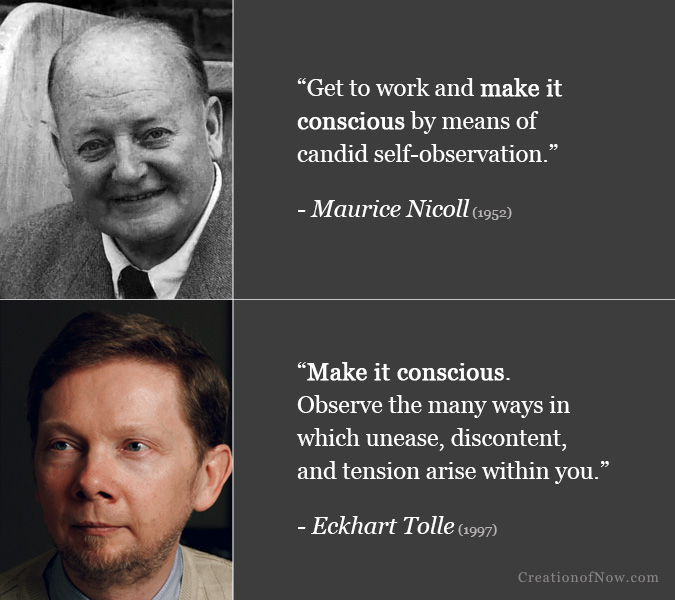
The phrase “make it conscious” is used in connection with the self-observation process in the work of both Nicoll and Tolle.
Read the article this image was featured in here.
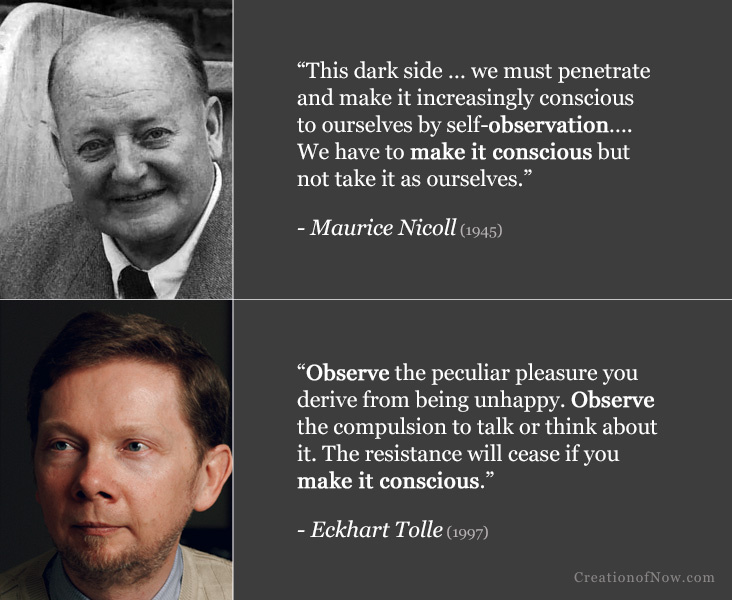
Nicoll and Tolle both encourage readers to make what is unconscious conscious through self-observation.
Read the article this image was featured in here.
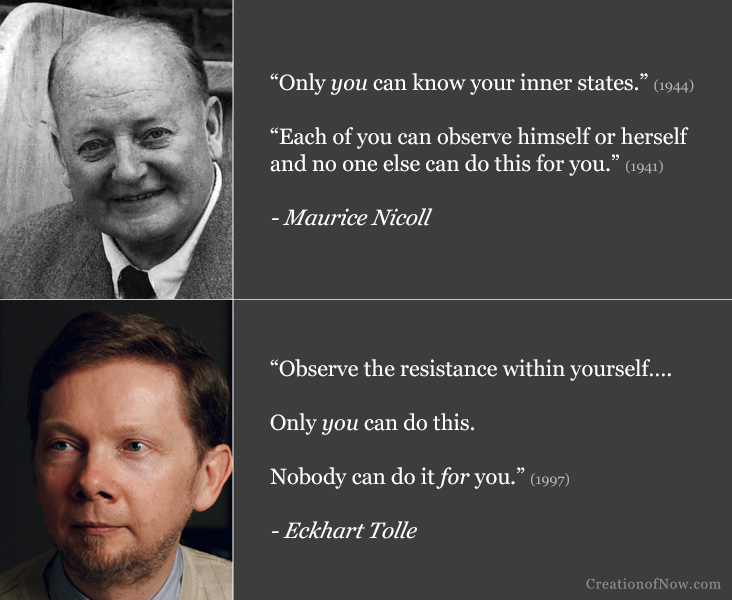
They emphasise that it’s up to you to observe your own inner states and no one else can do it for you.
Read the article this image was featured in here.
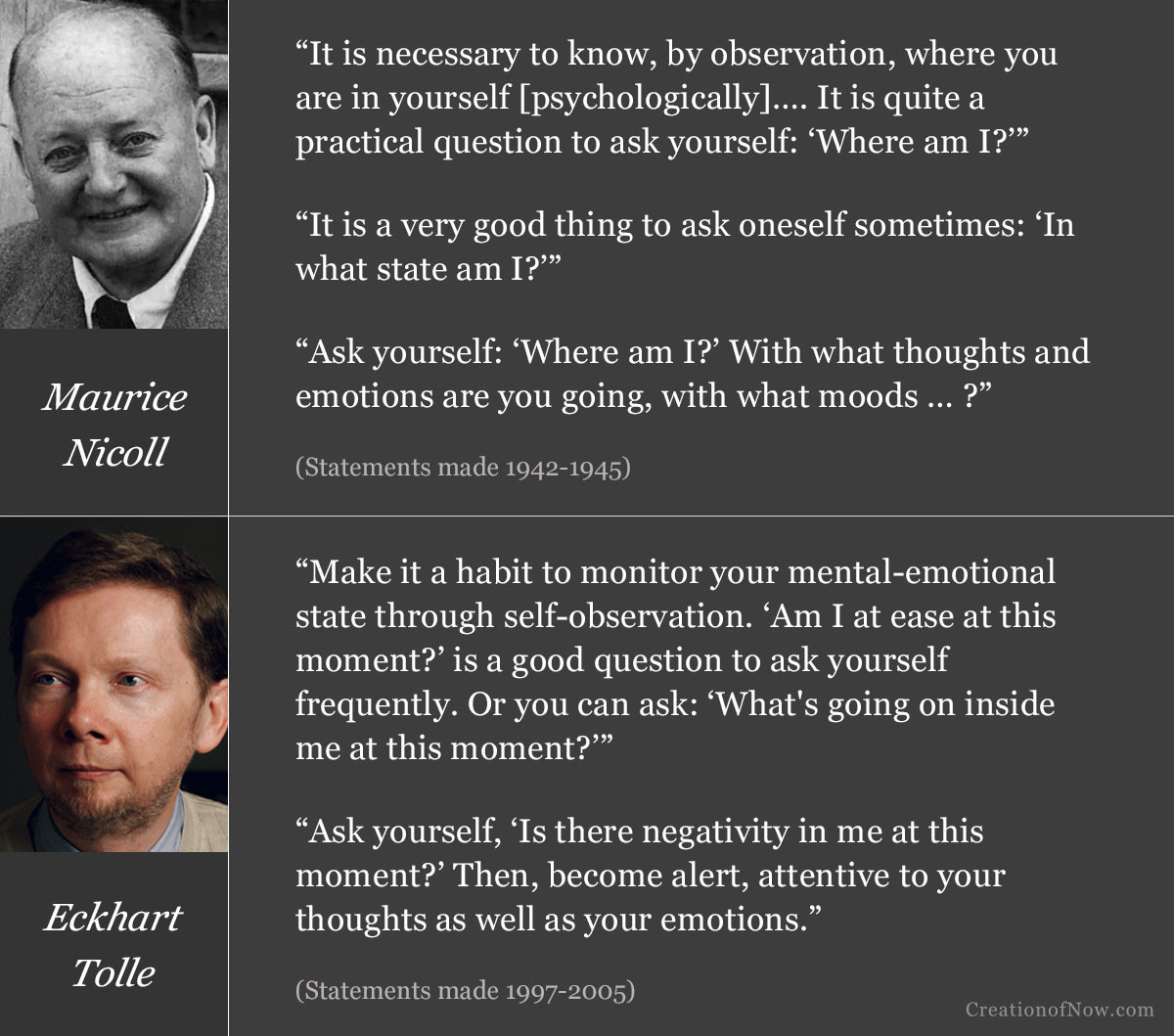
To prompt us to practice self-observation, Nicoll and Tolle suggest that we should pose questions to ourselves about our current psychological state.
Read the article this image was featured in here.
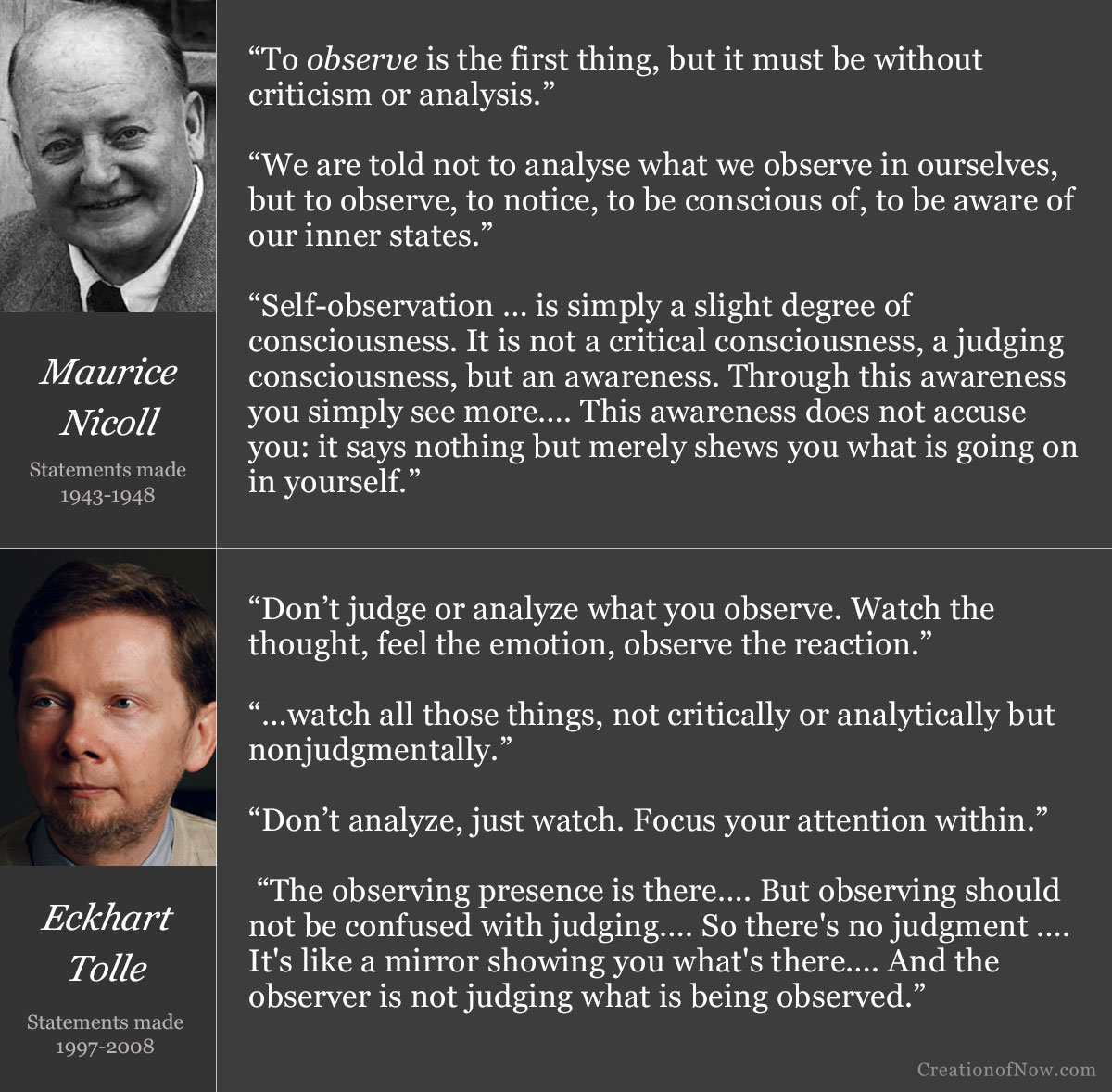
We’re advised to observe what is within us without any criticism, analysis, or judgement toward ourselves or what we see.
Read the article this image was featured in here.
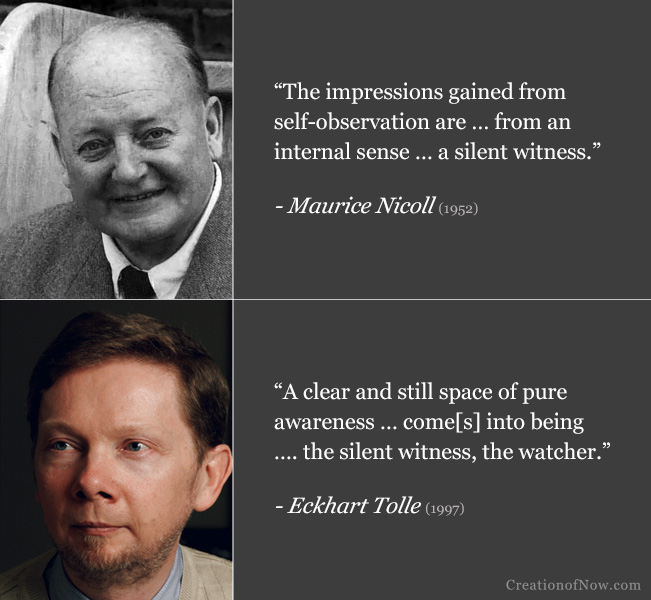
Both Nicoll and Tolle use the phrase “silent witness” to describe the inner sense of observation.
Read the article this image was featured in here.
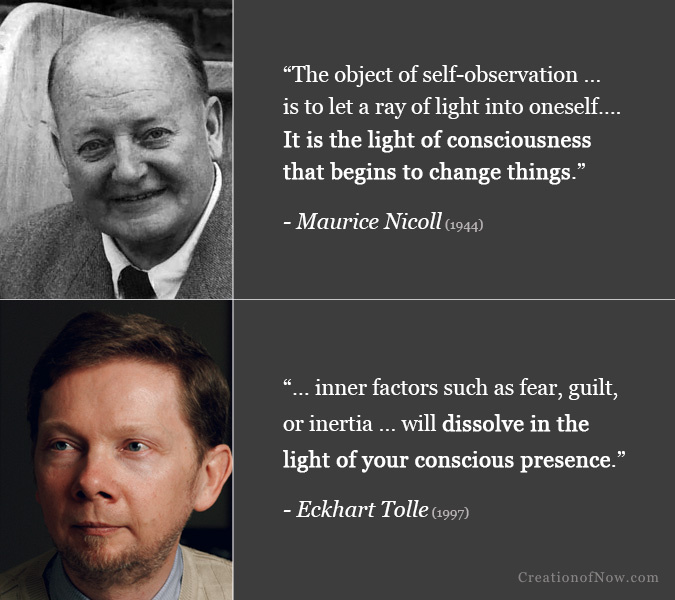
The light of consciousness/presence is often designated as the agent of inner change.
Read the article this image was featured in here.
Both Nicoll and Tolle explain that the inner reality of the psyche is more “real” or primary for an individual than the outer, physical reality.
Read the article this image was featured in here.
Both write that our inner life or state attracts the circumstances of our outer life.
Read the article this image was featured in here.
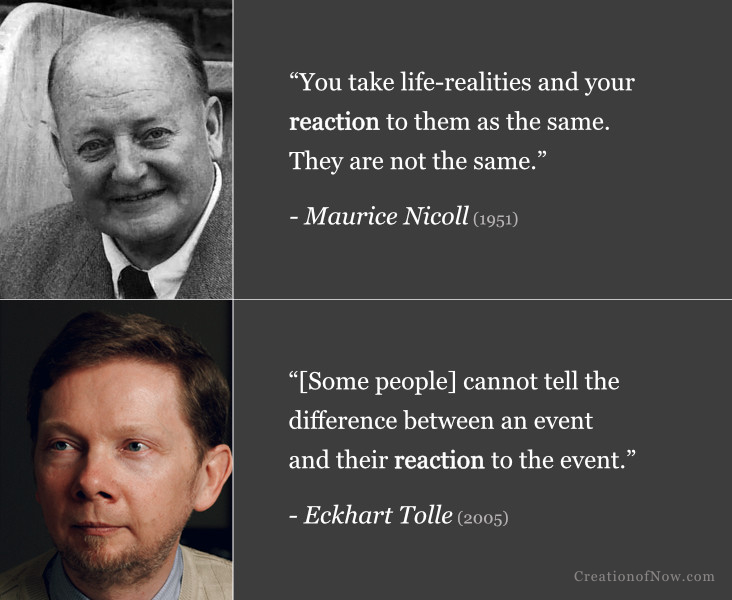
Nicoll and Tolle both emphasize a distinction between the external events of life and a person’s internal reaction to that event.
Read the article this image was featured in here.
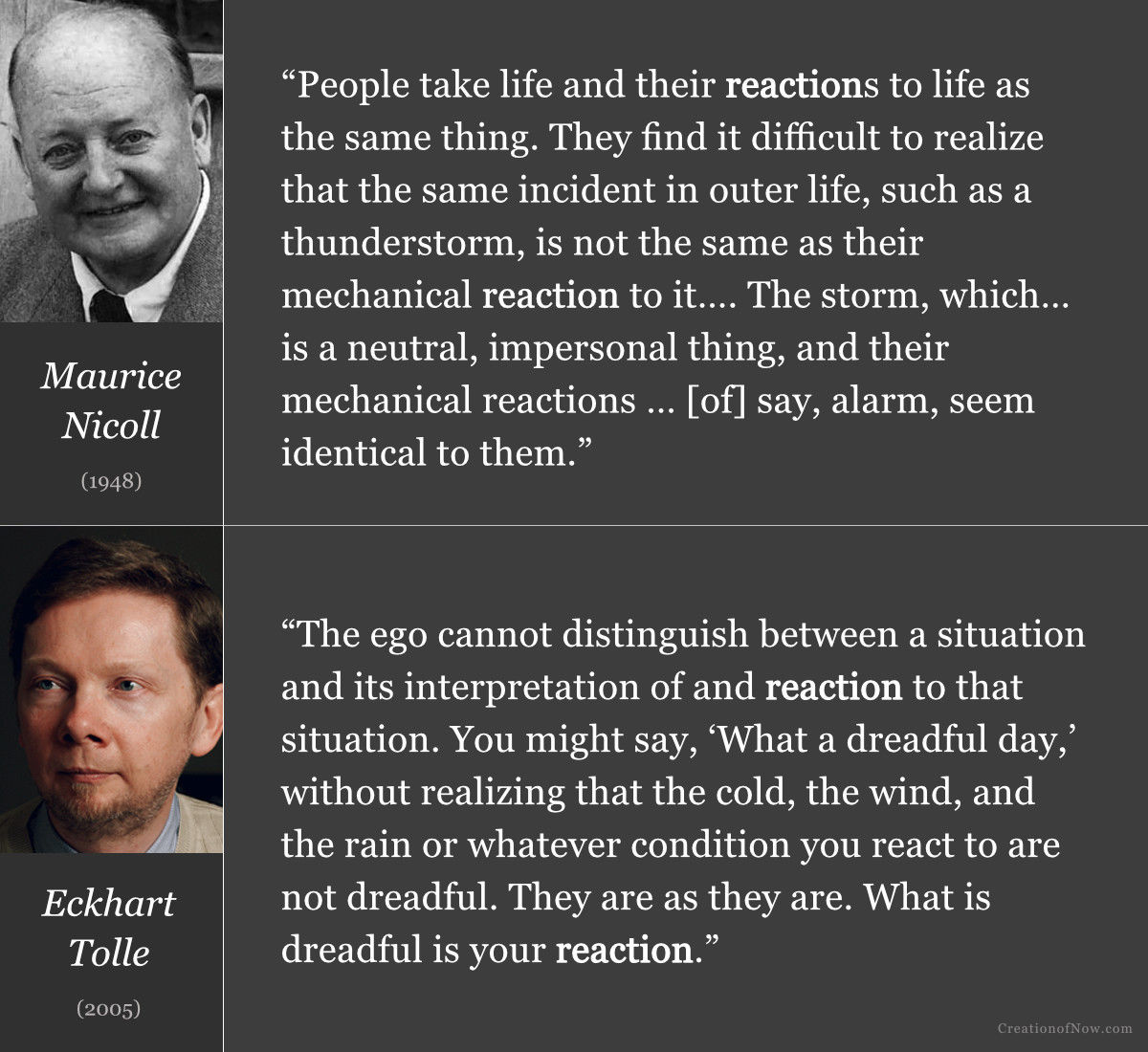
Using the example of bad weather, both authors explain how people fail to distinguish between external situations (which are neutral / impersonal) and the subjective internal reactions to those situations.
Read the article this image was featured in here.
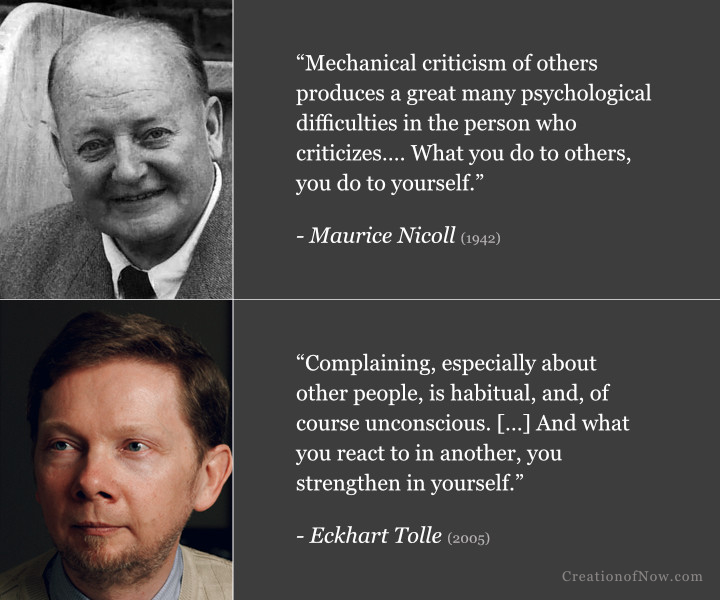
They emphasize that by criticizing other people, we strengthen faults and inner obstacles to spiritual progress.
Read the article this image was featured in here.
Both Nicoll and Tolle refer to the parable of Jesus about seeing a mote in your brother’s eye but not the beam in your own eye as an example of the importance of observing yourself instead of criticizing others.
Read the article this image was featured in here.
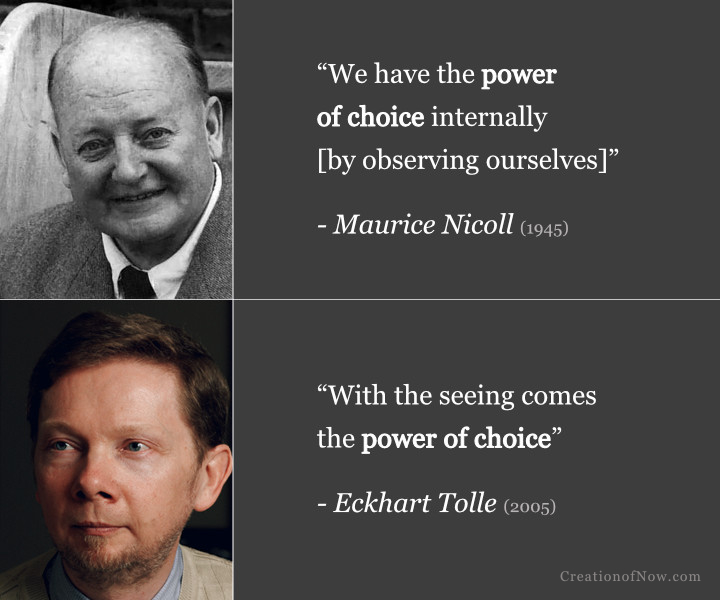
Both authors suggest that observing or seeing within brings the “power of choice.”
Read the article this image was featured in here.
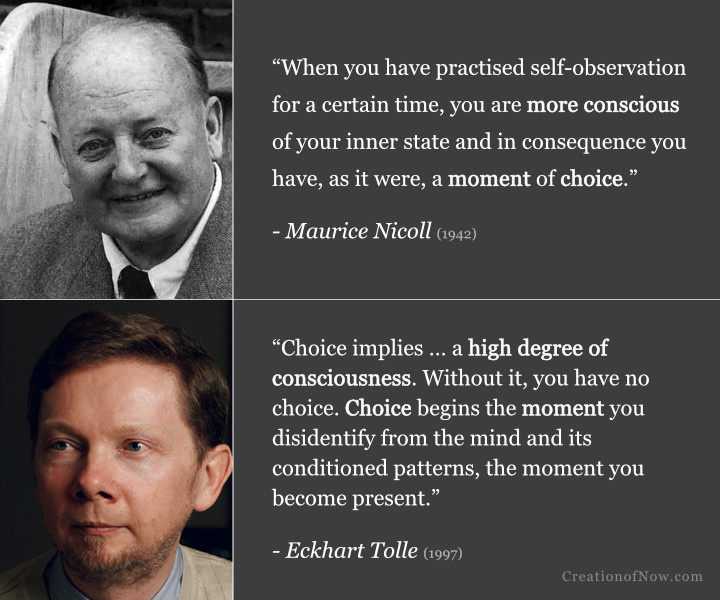
They indicate being more conscious of our inner state gives us a choice in the moment.
Read the article this image was featured in here.
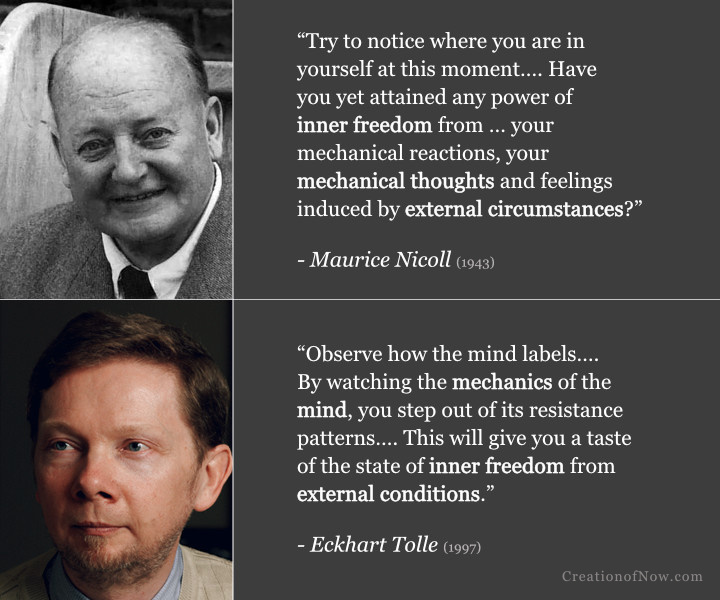
Nicoll and Tolle both emphasize the need to observe the mechanical nature of the psyche in order to achieve inner freedom from external circumstances / conditions.
Read the article this image was featured in here.
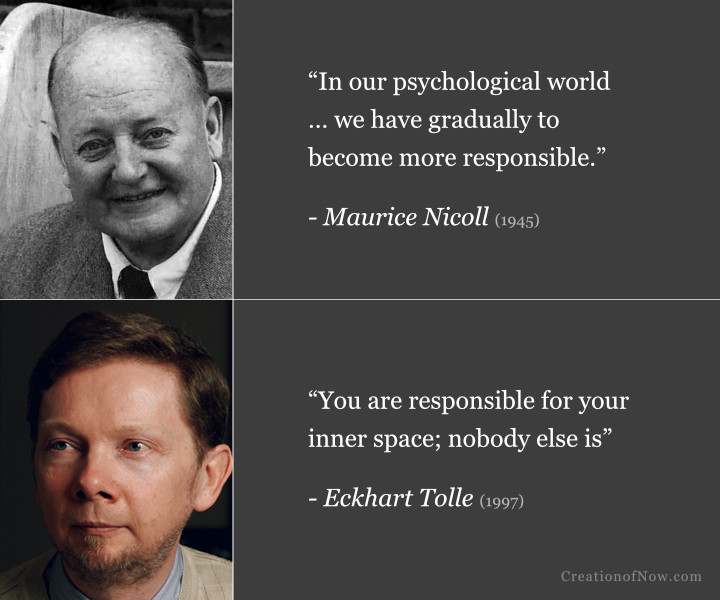
Nicoll and Tolle emphasise taking responsibility for your inner psychological world / inner space.
Read the article this image was featured in here.
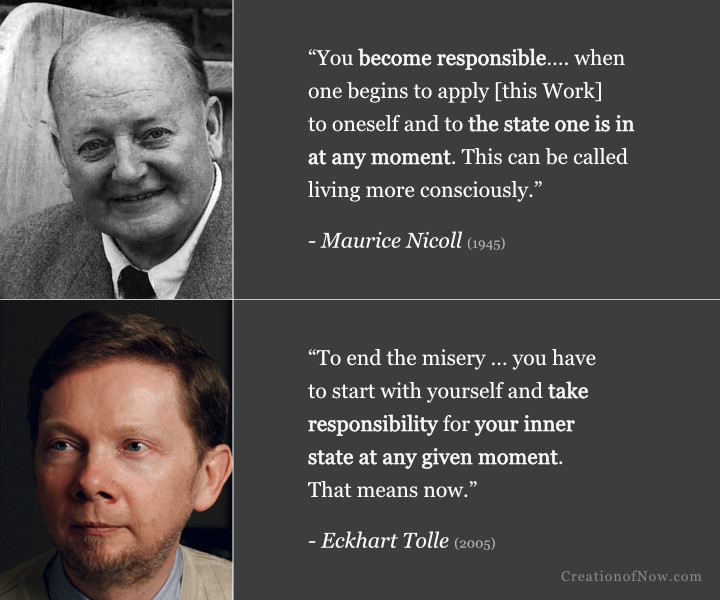
Both indicate the importance of taking responsibility for your inner state at any moment.
Read the article this image was featured in here.
They maintain that a lack of inner responsibility creates unhappiness in the world.
Read the article this image was featured in here.
They both describe how an immediate physical threat can trigger an instinctive fear reaction – something humans and animals have in common. Both also describe the fear producing physical sensations, such as muscle contraction, and a fight-or-flight response.
Read the article this image was featured in here.
Nicoll and Tolle both direct readers to observe how negativity drains one’s force / vital energy.
Read the article this image was featured in here.
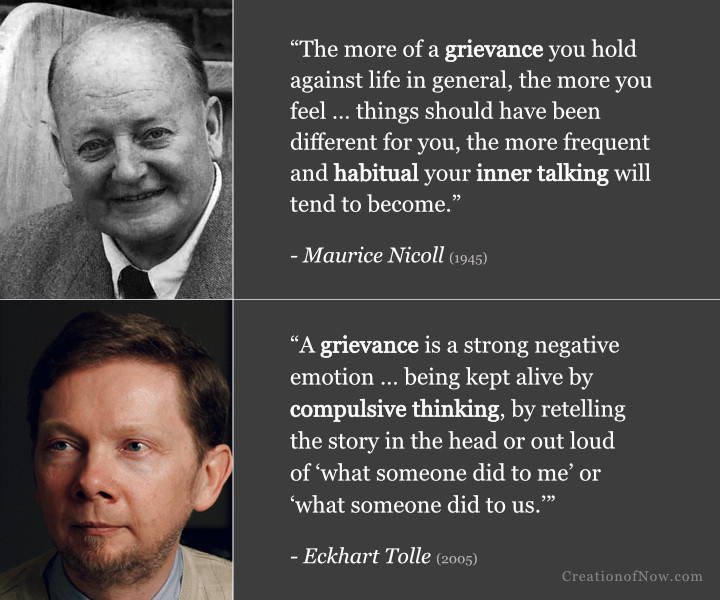
Nicoll and Tolle both describe how grievances are often expressed inwardly as inner talking / compulsive thinking.
Read the article this image was featured in here.
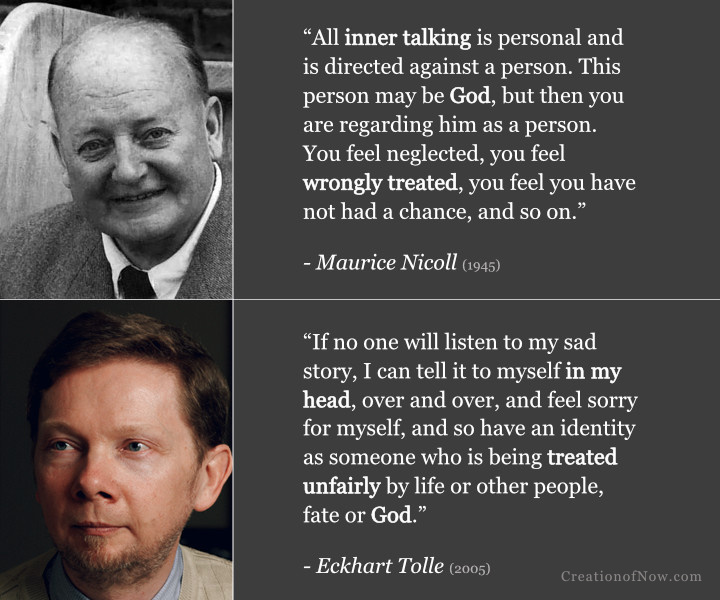
Persistent negative trains of thought can be fueled by feeling unfairly treated by others or even God, they tell us.
Read the article this image was featured in here.
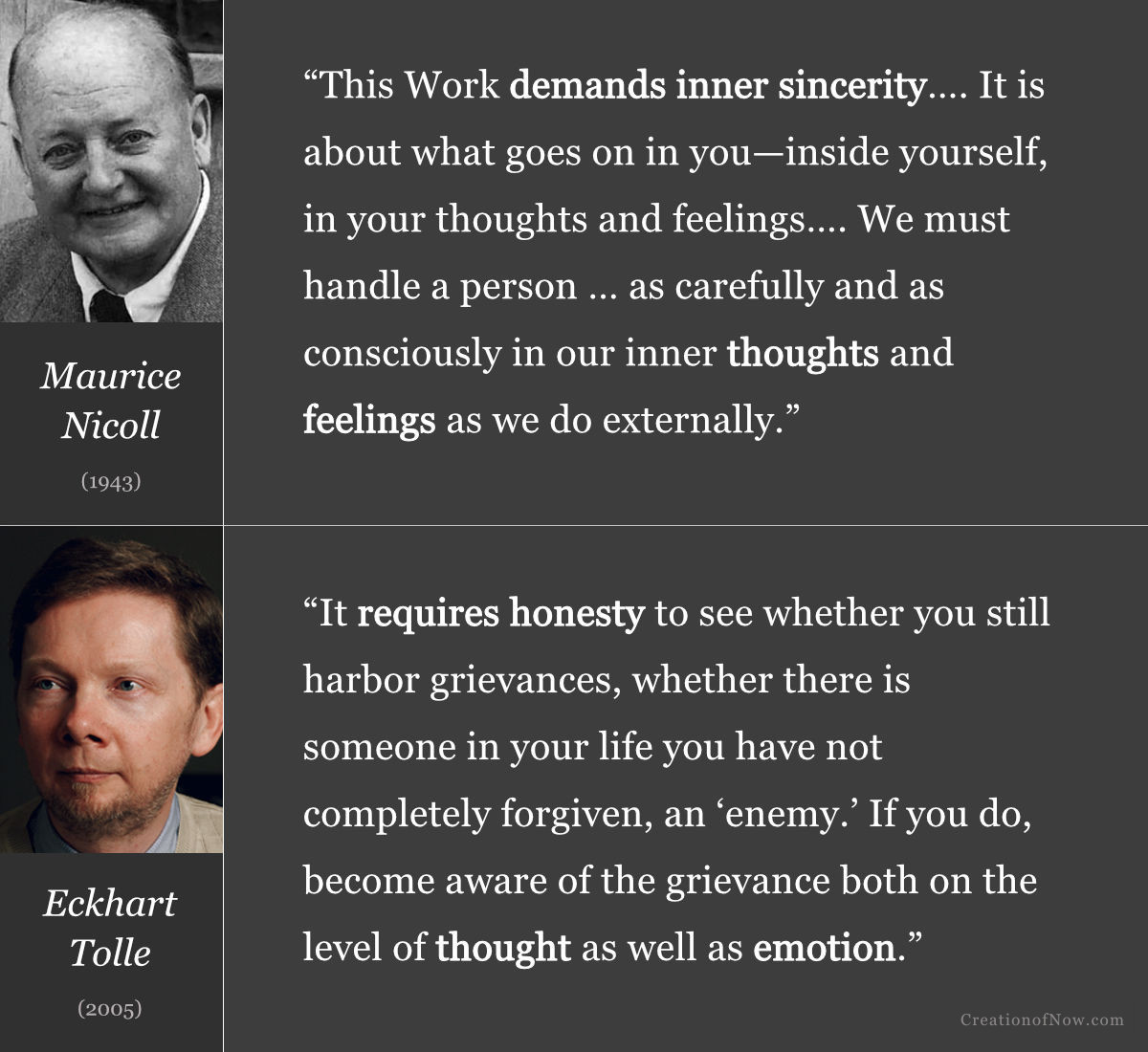
It takes sincerity or honesty to recognise any negativity directed towards others in our thoughts and feelings, they tell us.
Read the article this image was featured in here.
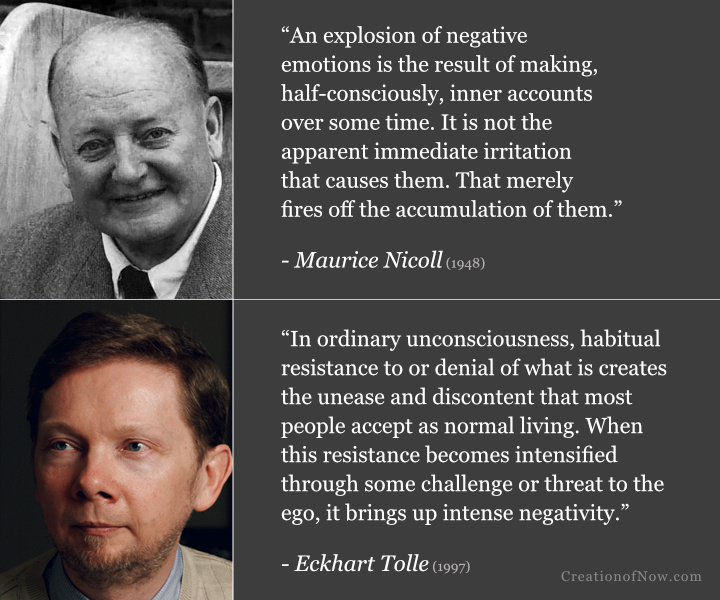
Both authors describe how negativity accumulates over time beneath the surface, which can cause disproportionate emotional responses to external irritants or challenges.
Read the article this image was featured in here.
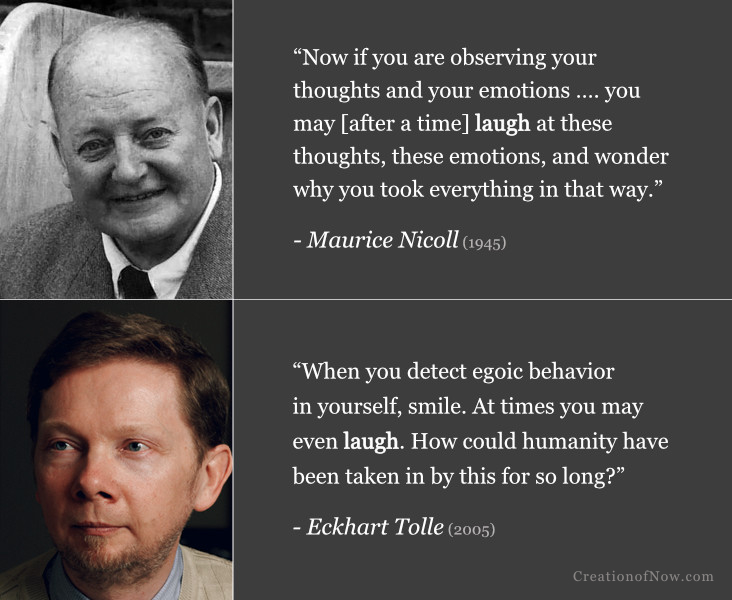
They describe how, after observing themselves, a person might laugh at the thoughts and emotions they see and how ridiculous they are.
Read the article this image was featured in here.
Nicoll and Tolle both explain that a person can discover the truth of who they are only by gradually identifying what they are not.
Read the article this image was featured in here.
The illusory or imaginary “I” or identity we cling to, and its fictitious self-image/pictures, will start to dissolve or collapse when brought into the light of consciousness, the authors say.
Read the article this image was featured in here.
We mistake the false self for who we are, the authors say, but when we observe or recognize what’s in us clearly, our illusory/imaginary self begins to dissolve.
Read the article this image was featured in here.
Negativity Within
These comparisons come from articles comparing how Tolle and earlier authors discuss how negativity operates in the psyche and its detrimental effects.
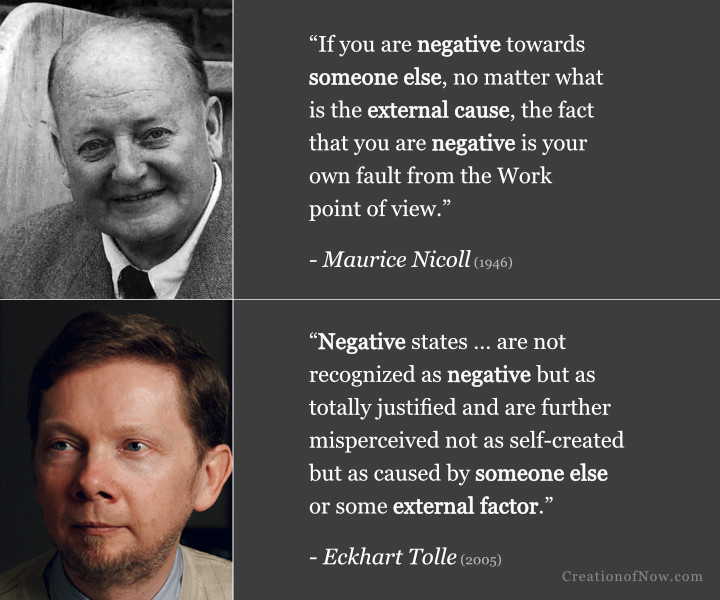
Nicoll and Tolle both emphasize that each person is responsible for their own negative inner states, regardless of external situations or the actions of others.
Read the article this image was featured in here.
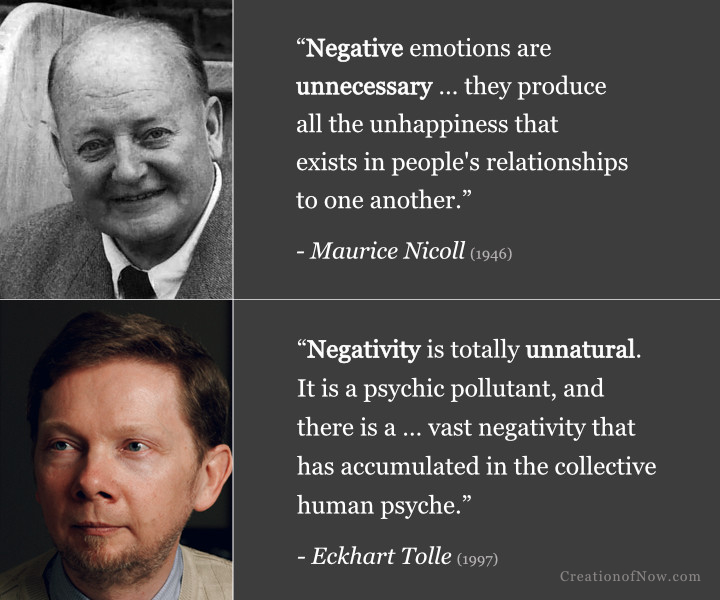
Emotional negativity is unnecessary / unnatural, they suggest, and detrimental to humanity.
Read the article this image was featured in here.
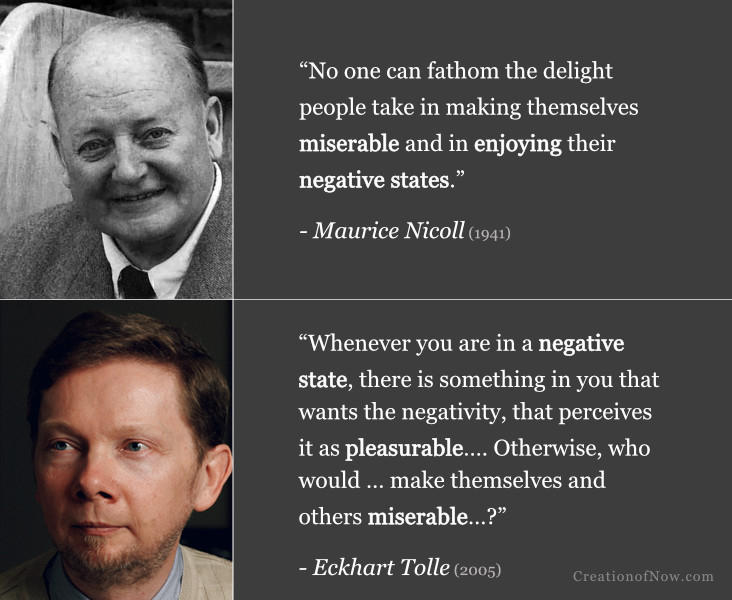
Both authors describe how people take enjoyment / pleasure out of negative states and being miserable.
Read the article this image was featured in here.
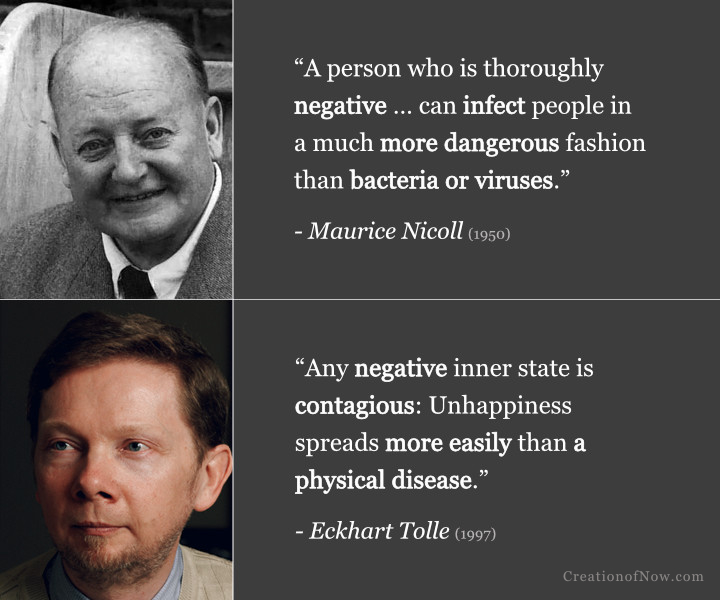
Our inner negativity is infectious or contagious, even more so than physical disease, Nicoll and Tolle both say.
Read the article this image was featured in here.
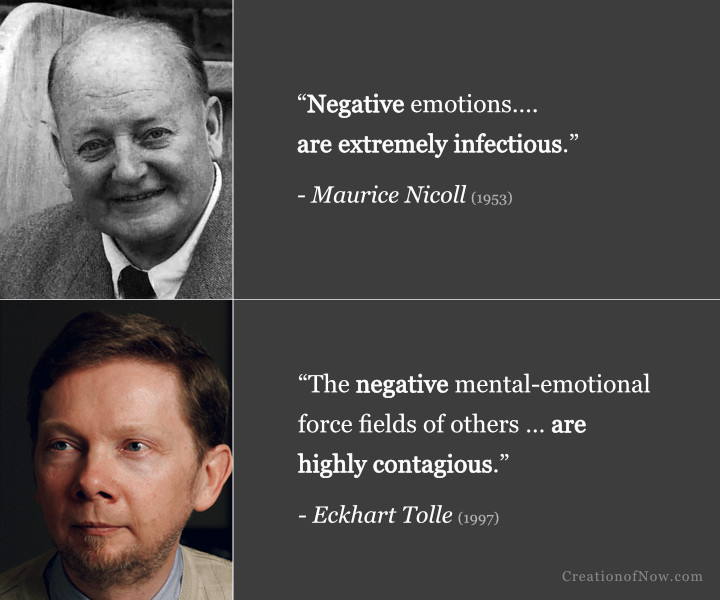
Both authors emphasise that negativity is infectious or contagious and can spread from person to person.
Read the article this image was featured in here.
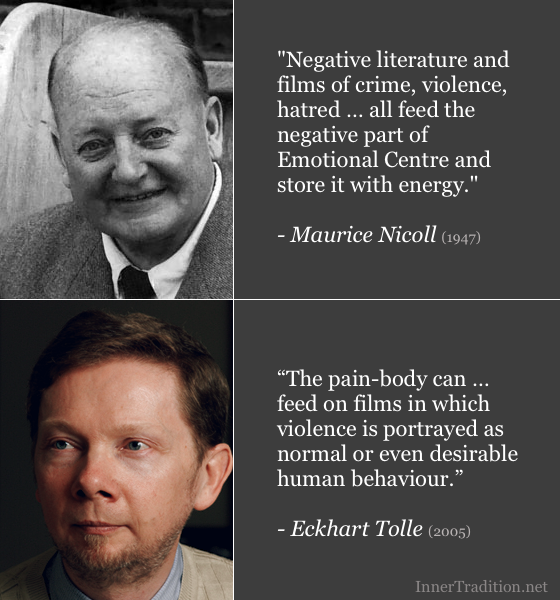
Both Nicoll and Tolle state that violent films can “feed” the negative part of the Emotional Center (Nicoll) or pain-body (Tolle).
Read the article this image was featured in here.
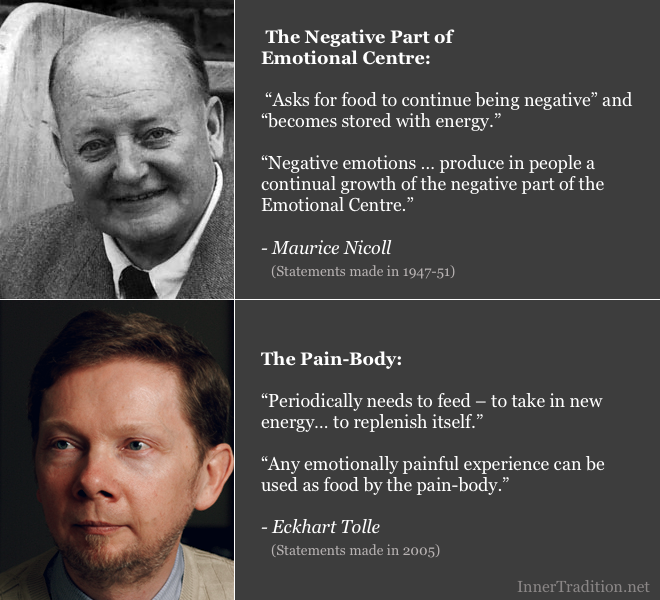
Nicoll and Tolle describe how negative or painful emotions are used as “food” or “energy” for the negative part of the emotional center or pain-body respectively.
Read the article this image was featured in here.
The negative emotions of parents will cause their child to accumulate negative emotions too. This then fosters the growth and development of a negative emotional part or pain-body in the child, according to Nicoll and Tolle.
Read the article this image was featured in here.
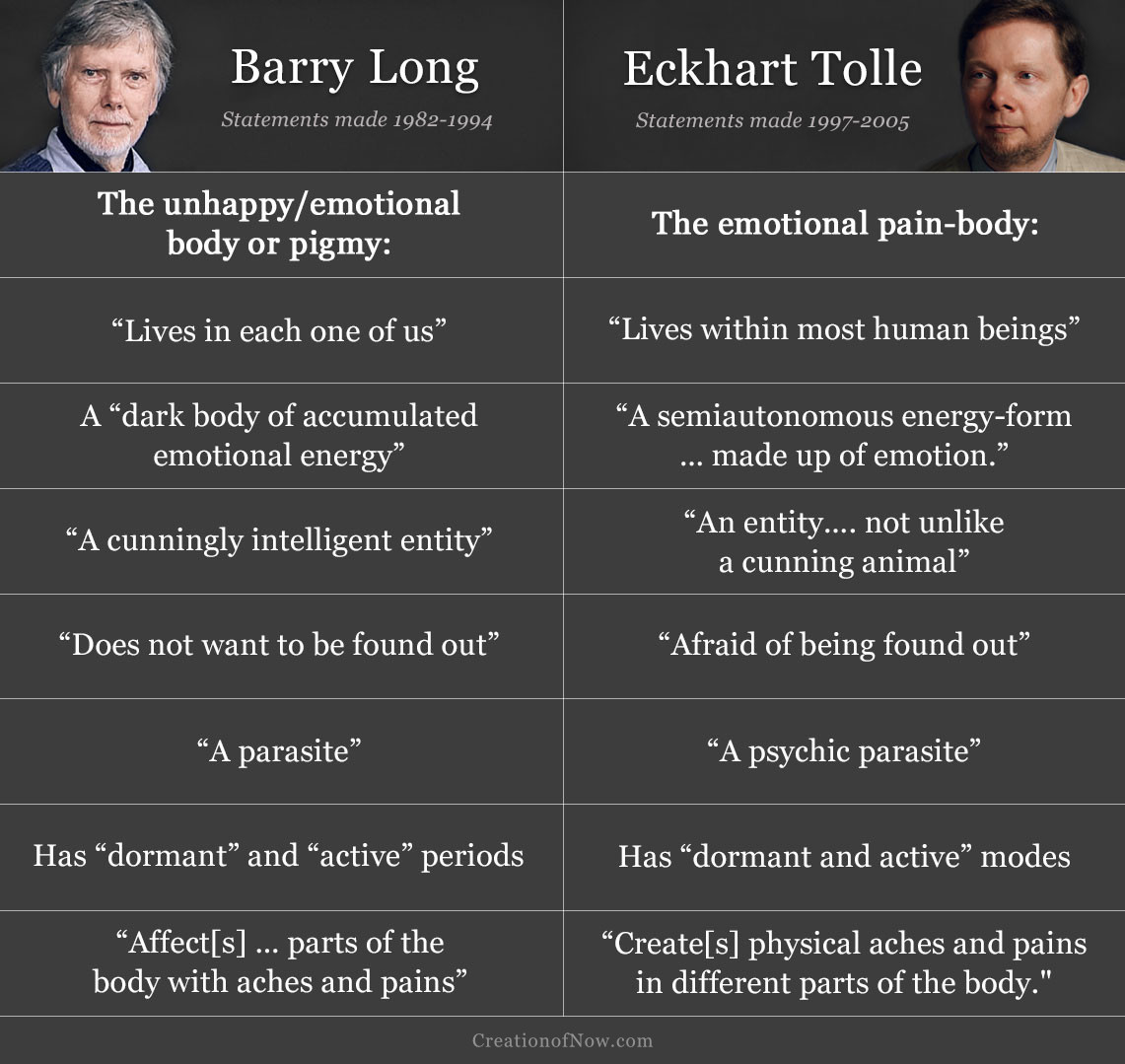
Both Barry Long and Tolle state that people have a parasitic entity living within, called the emotional body / pigmy (Long) or emotional pain-body (Tolle). Their description of this entity has numerous similarities, such as that it is made of energy, is cunning, does not want to be found out, has dormant and active periods, and can cause aches and pains in the body.
Read the article this image was featured in here.
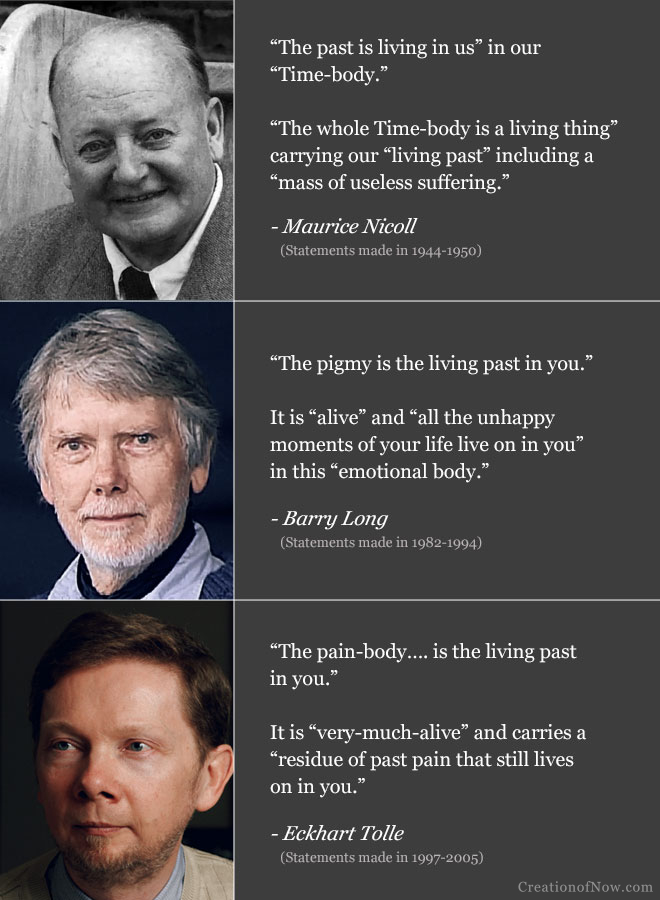
Nicoll, Long, and Tolle all state how past emotional pain or suffering continues to exist in people within the Time-body (Nicoll), pigmy (Long), or pain-body (Tolle). They all suggest this body is alive and carries the “living past” in us.
Read the article this image was featured in here.
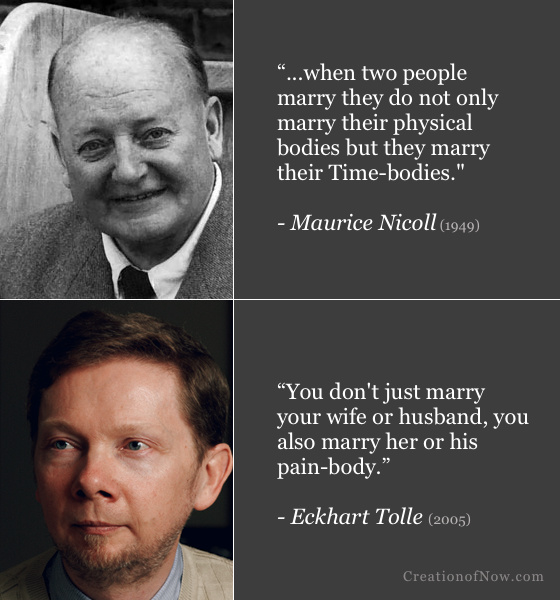
When two people marry, they’re also said to marry each-other’s Time-bodies (Nicoll) or pain-bodies (Tolle).
Read the article this image was featured in here.
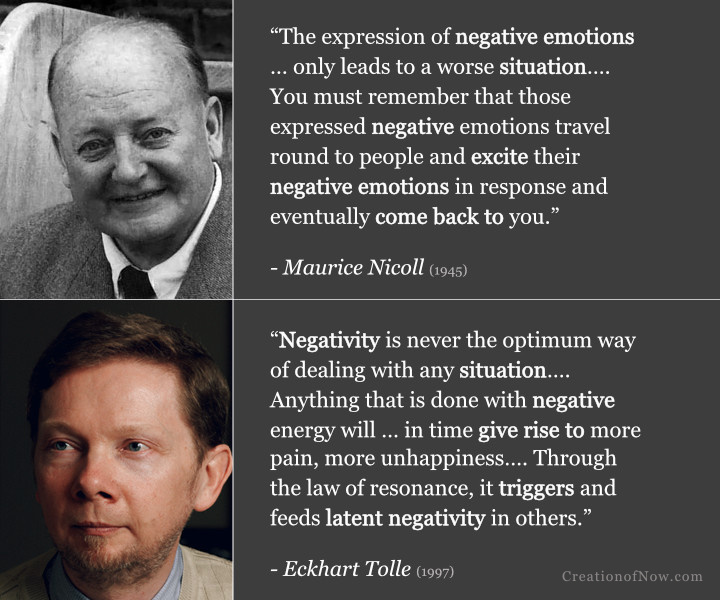
They both explain how the expression of negative emotions / negative energy triggers latent negativity in others as well.
Read the article this image was featured in here.
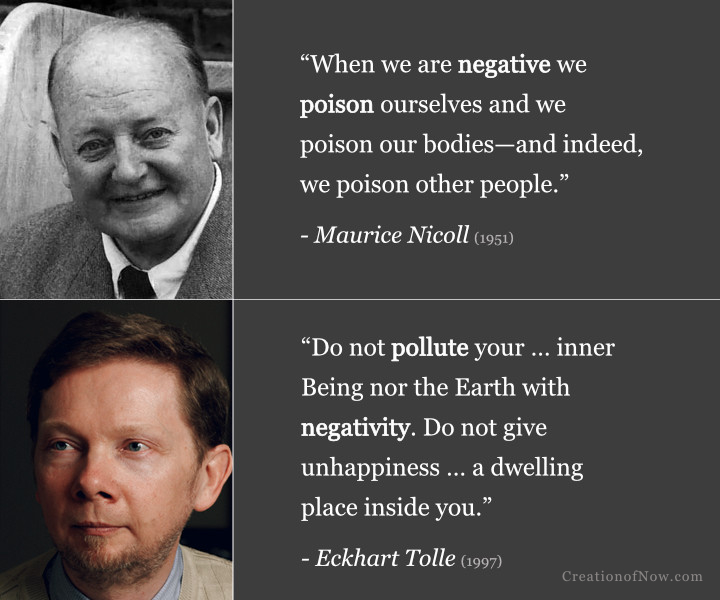
Nicoll and Tolle describe negativity as an inner poison or pollutant affecting ourselves and others.
Read the article this image was featured in here.
Nicoll and Tolle both direct readers to observe how negativity drains one’s force / vital energy.
Read the article this image was featured in here.
Nicoll and Tolle suggest that negative emotions disturb energy circulation within us, potentially leading to illness.
Read the article this image was featured in here.
They describe how negative thoughts or emotions drain energy from the body, which can cause illness / disease.
Read the article this image was featured in here.
Negativity can worsen a disease and cause it to persist or become chronic, the authors maintain. (“If you complain, feel self-pity, or resent being ill, your ego becomes stronger,” writes Tolle)
Read the article this image was featured in here.
Both indicate negative emotions can harm health and lower one’s resistance to illness.
Read the article this image was featured in here.
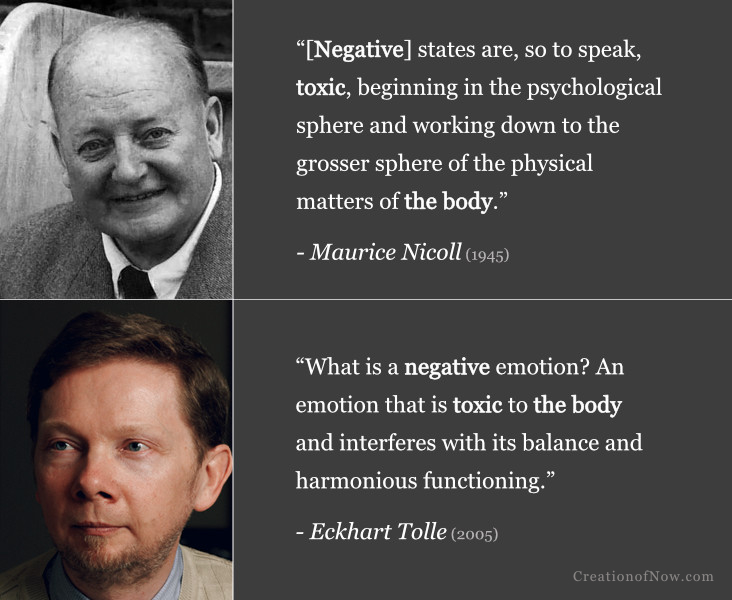
Both Nicoll and Tolle describe negativity as toxic to a person. They state it has effects not just on the psyche but also on the physical body.
Read the article this image was featured in here.
Nicoll and Tolle suggest negativity can express or manifest physically as a disorder or illness.
Read the article this image was featured in here.
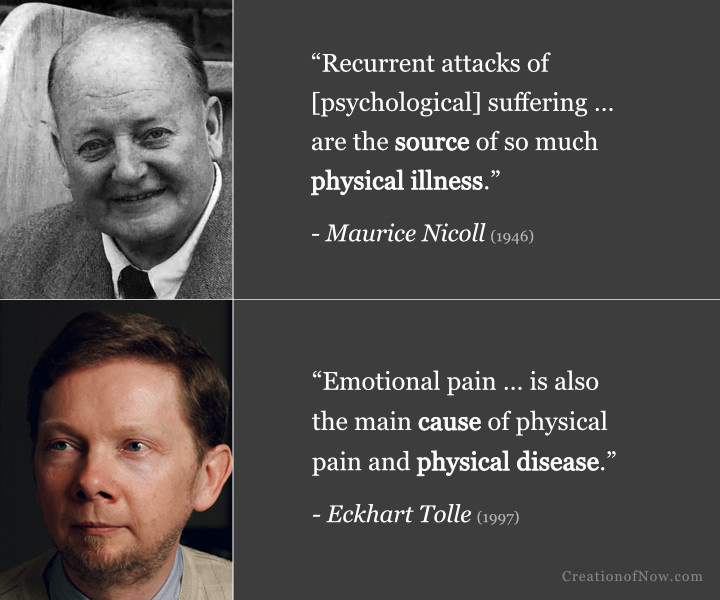
Both state that psychological pain and suffering can give rise to physical disease.
Read the article this image was featured in here.
Nicoll and Tolle both describe how grievances are often expressed inwardly as inner talking / compulsive thinking.
Read the article this image was featured in here.
Persistent negative trains of thought can be fueled by feeling unfairly treated by others or even God, they tell us.
Read the article this image was featured in here.
They highlight the importance of inner forgiveness for spiritual growth and connect this to Jesus’ teaching to forgive or make peace with your enemies.
Read the article this image was featured in here.
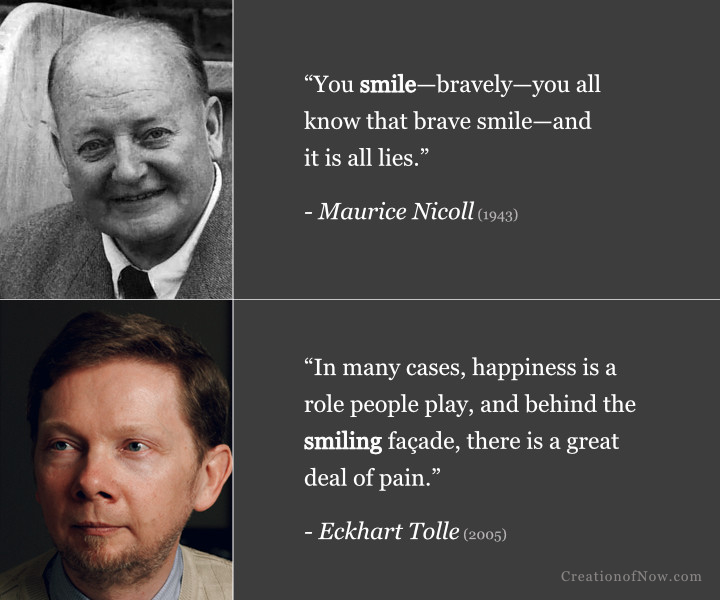
Nicoll and Tolle both state that a person’s smiling exterior can be a lie / façade hiding inner pain.
Read the article this image was featured in here.
Both authors describe how negativity accumulates over time beneath the surface, which can cause disproportionate emotional responses to external irritants or challenges.
Read the article this image was featured in here.
Eckhart Tolle, Barry Long and the “pain body”
This set of quotes comparisons showcases specific similarities between Tolle and Long on the concept Tolle calls the “pain-body”—a notion also encountered in the previous slideshow.
“ ‘Your “unhappy body” is composed entirely of . . . painful emotional material, [so] I will refer to it . . . as your emotional body.’
- Barry Long (1994)
“ ‘Almost everyone carries . . . an accumulation of old emotional pain which I call “the pain body”’
- Eckhart Tolle (2005)
“ It is a ‘dark body of accumulated emotional energy’
- Barry Long (1987)
“ It is ‘a semi-autonomous energy-form . . . made up of emotion’
- Eckhart Tolle (2005)
“ ‘[Your] earliest of emotions did not remain fragmented. In their pain and isolation they drew together inside you.’
- Barry Long (1994)
“ ‘The remnants of pain left behind by every strong negative emotion . . . join together . . . in the very cells of your body.’
- Eckhart Tolle (2005)
“ It ‘lives in each one of us’
- Barry Long (1987)
“ It ‘lives within most human beings’
- Eckhart Tolle (2005)
“ ‘By the time your “unhappy body” matures, you are emotionally hooked — addicted to . . . emotional pain or unhappiness.’
- Barry Long (1994)
“ ‘Any emotionally painful experience can be used as food by the pain-body. . . . The pain-body is an addiction to unhappiness.’
- Eckhart Tolle (2005)
“ It’s ‘a cunningly intelligent entity’
- Barry Long (1987)
“ It’s ‘an entity . . . [with] primitive intelligence, not unlike a cunning animal’
- Eckhart Tolle (2005)
“ ‘Is the living past in you’
- Barry Long (1987)
“ ‘It is the living past in you’
- Eckhart Tolle (1997)
“ ‘A parasite’
- Barry Long (1994)
“ ‘A psychic parasite’
- Eckhart Tolle (2005)
“ ‘Does not want to be found out’
- Barry Long (1994)
“ ‘Afraid of being found out’
- Eckhart Tolle (1997)
“ ‘Does not want to die’
- Barry Long (1994)
“ ‘Wants to survive’
- Eckhart Tolle (1997)
“ Has ‘dormant’ and ‘active’ periods
- Barry Long (1994)
“ Has ‘dormant and active’ modes
- Eckhart Tolle (1997)
“ ‘Responsible for all your negative moods . . . and unhappiness.’
- Barry Long (1987)
“ ‘Any sign of unhappiness in yourself, in whatever form . . . may be the . . . pain-body.’
- Eckhart Tolle (1997)
“ ‘Affect[s] . . . parts of the body with aches and pains.’
- Barry Long (1994)
“ ‘Creates[s] physical aches and pains in different parts of the body.’
- Eckhart Tolle (1997)
The Law of Opposites
These come from articles comparing how Nicoll and Tolle discuss what has been called the “law of opposites”.
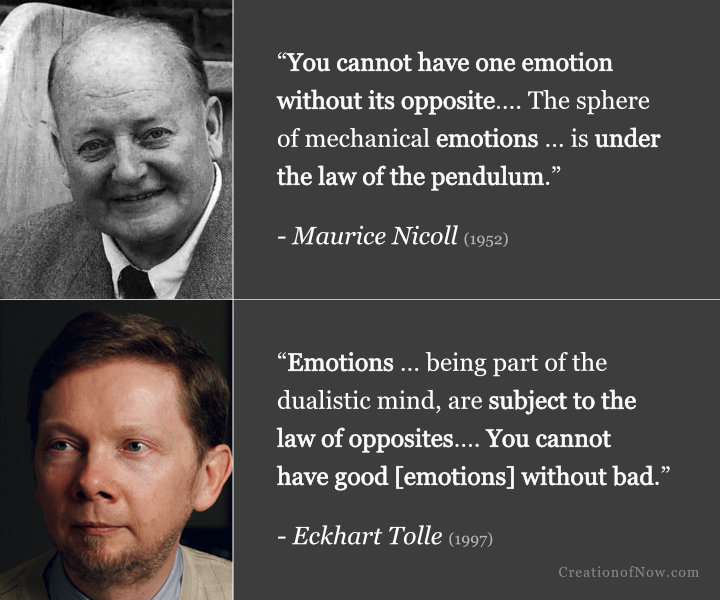
You cannot have one emotion without experiencing its opposite, the authors explain, as emotions are subject to the law of opposites.
Read the article this image was featured in here.
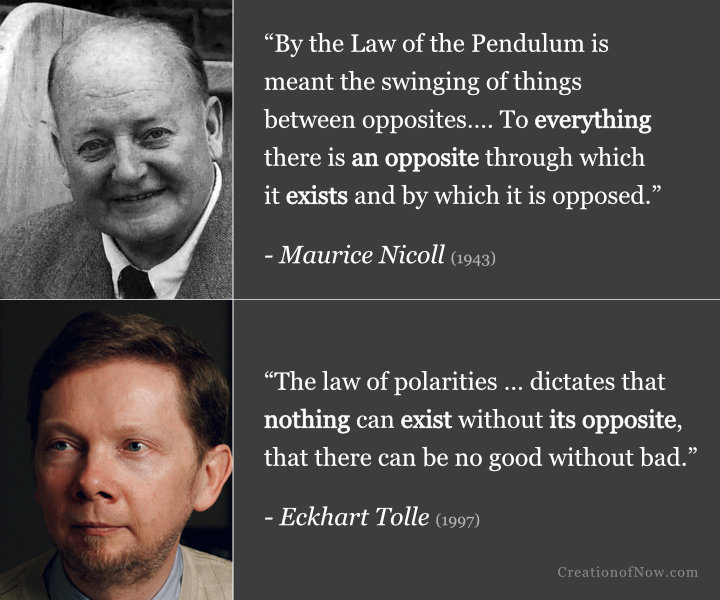
Everything in the universe has an opposite it cannot exist without, according to the law of the pendulum/polarities.
Read the article this image was featured in here.
The opposites of birth and death are fundamental to the manifest universe, and there are cycles between them, according the law of opposites.
Read the article this image was featured in here.
Cycles between opposite conditions occur on large and small scales: in the ascent and decline of nations, and in our own lives, Nicoll and Tolle say.
Read the article this image was featured in here.
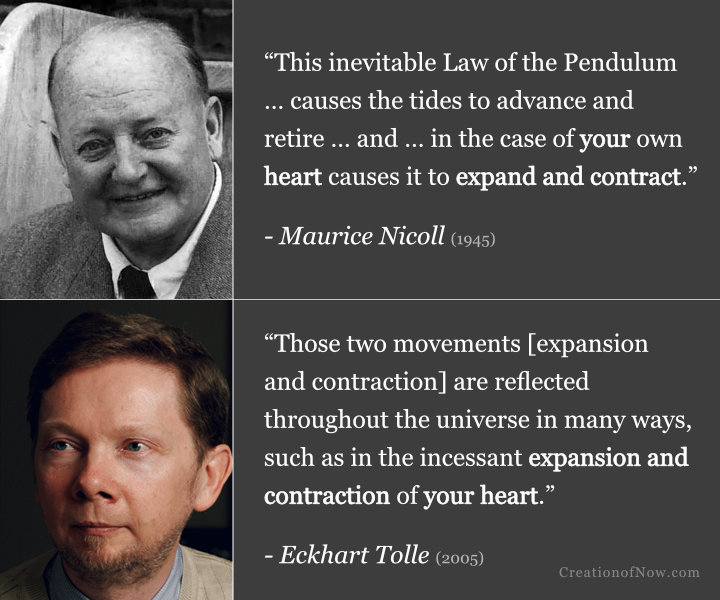
The two opposite movements of expansion and contraction, occurring throughout life in various ways, is present in the beating of our heats, the authors tell us.
Read the article this image was featured in here.
Due to the law of opposites, there will be times when things go right and times when they go wrong for us, or cycles of gain and loss in our lives, Nicoll and Tolle suggest.
Read the article this image was featured in here.
We should not become despondent during the negative swing or cycles of this law upon us, but learn to use such times for inner growth, the authors suggest.
Read the article this image was featured in here.
Our ordinary thoughts and emotions function in opposites, according to this law.
Read the article this image was featured in here.
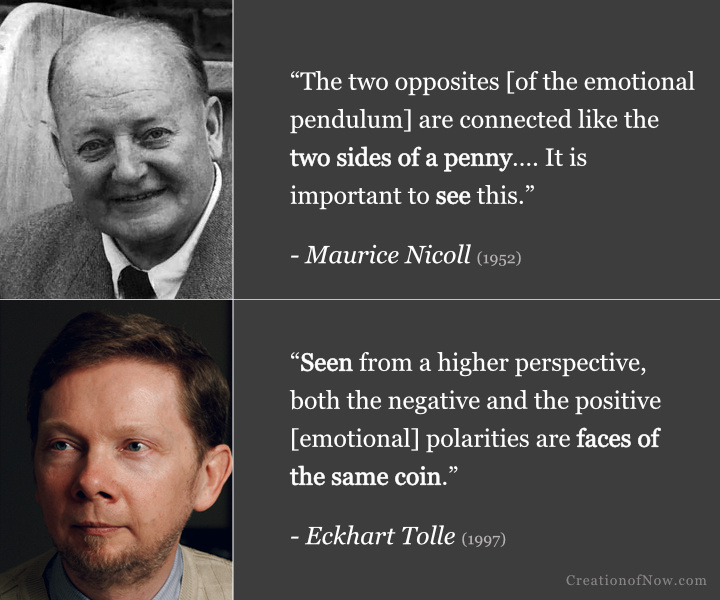
Opposite emotional states are really two sides of the same coin or penny, Nicoll and Tolle convey.
Read the article this image was featured in here.
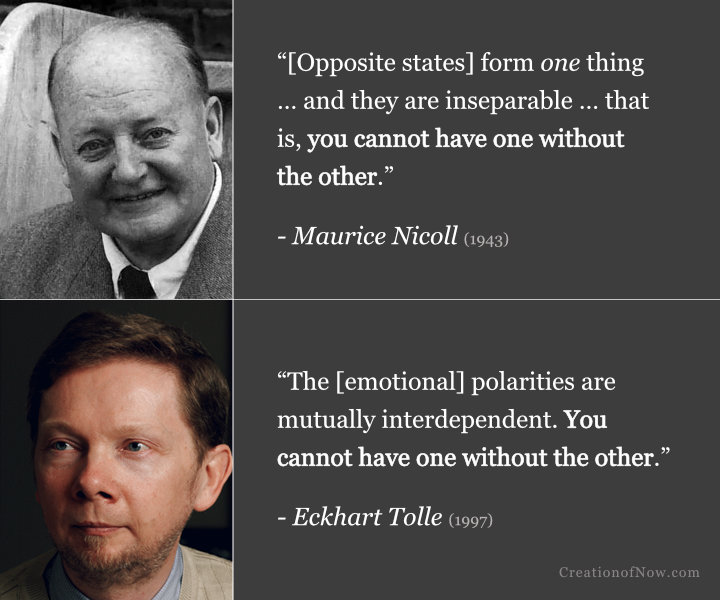
When it comes to opposite states or emotions, “you cannot have one without the other,” the authors tell us, as they are inseparable.
Read the article this image was featured in here.
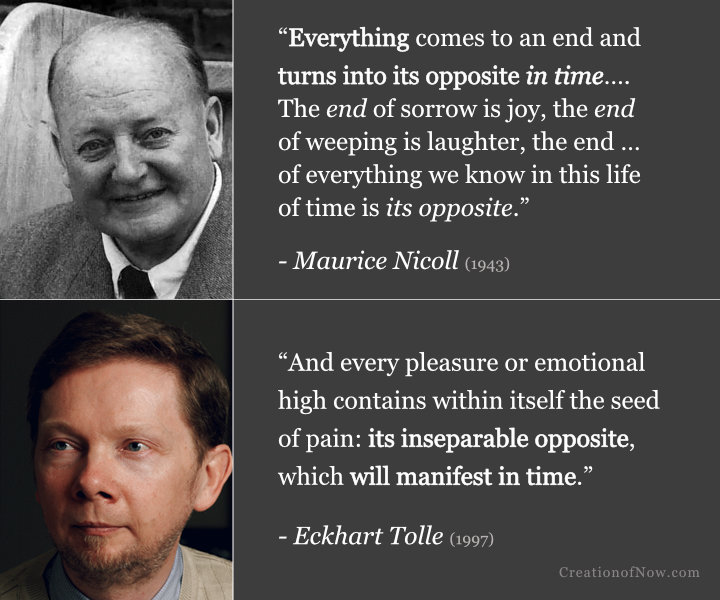
All our ordinary emotional states, like everything else in existence, will eventually turn into their opposite “in time” due to the action of the law of opposites, we are told.
Read the article this image was featured in here.
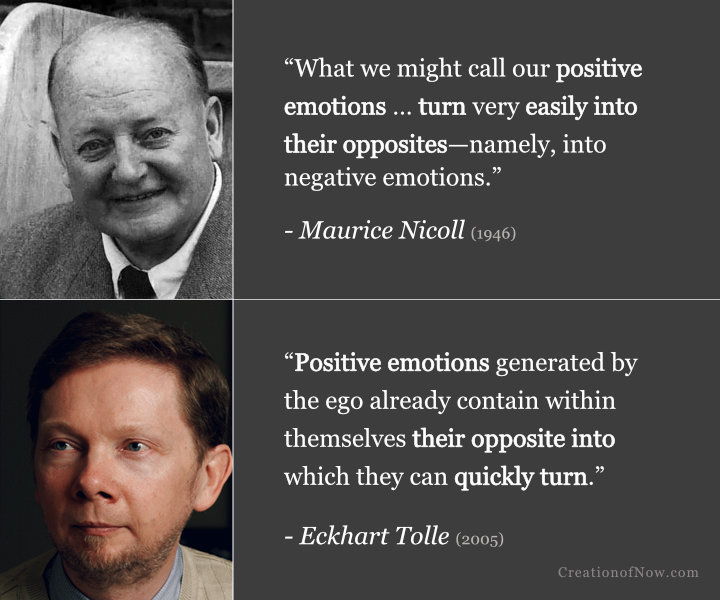
What we consider to be “positive emotions” can turn rapidly in their opposite, Nicoll and Tolle tell us.
Read the article this image was featured in here.
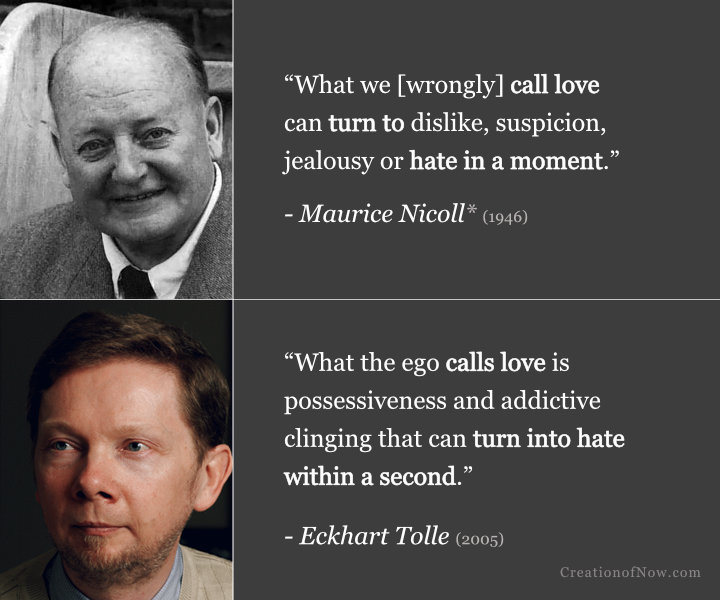
The emotion often called “love” is not true love, and can turn into hate in a moment/second, the authors convey. *Note: Nicoll is paraphrasing Ouspensky here.
Read the article this image was featured in here.
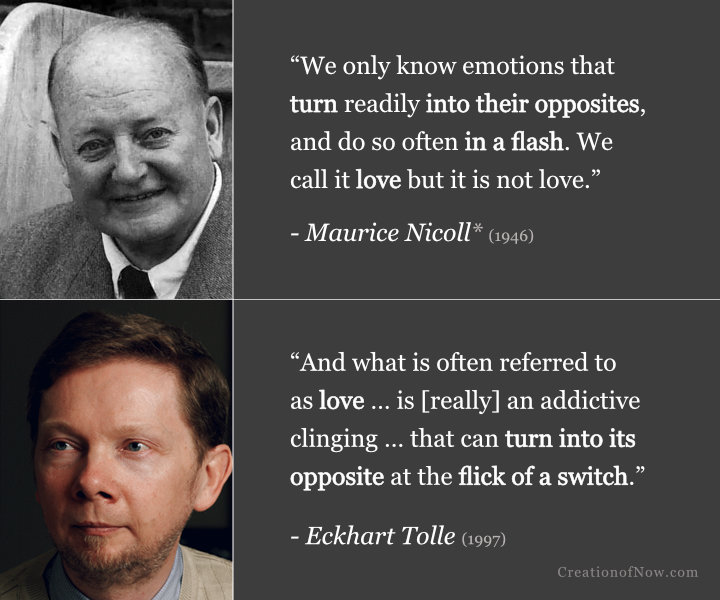
What we often regard as love can turn into its opposite “in a flash” or “at the flick of a switch” Nicoll and Tolle respectively say. *Note: Nicoll is paraphrasing Ouspensky here.
Read the article this image was featured in here.
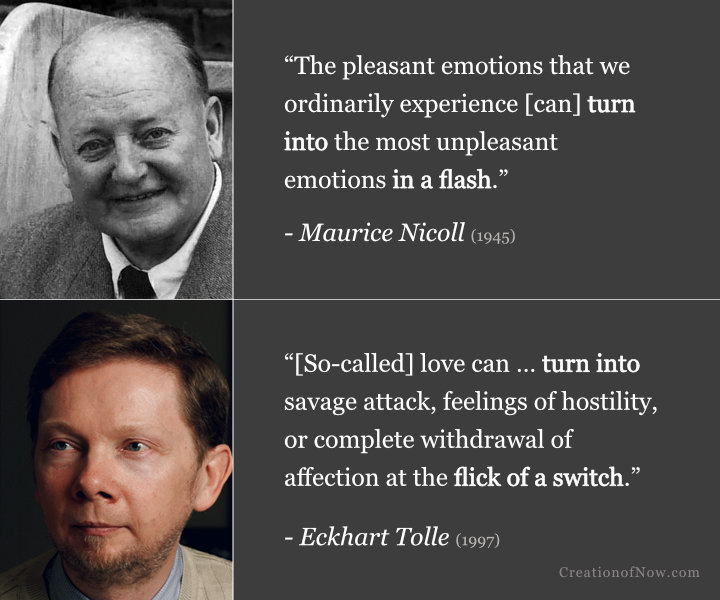
Pleasant emotions or pseudo “love” can turn into something negative “in a flash” or “flick of a switch,” the authors respectively suggest.
Read the article this image was featured in here.
Praise or flattery can make us feel good, but the lack of it can make us feel bad, the authors say. This is an example of how ordinary emotions work in opposites.
Read the article this image was featured in here.
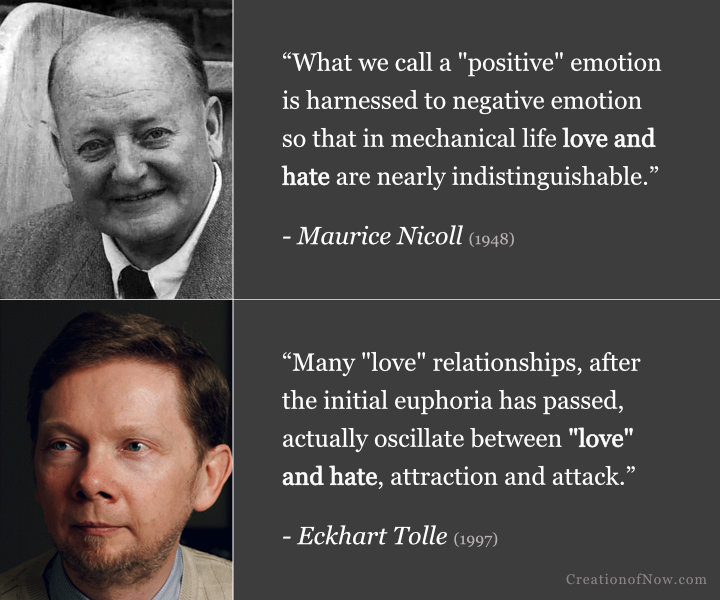
Because the unconscious emotional polarities are connected, so-called “love” is linked to hate, so love and hate often go together for many people.
Read the article this image was featured in here.
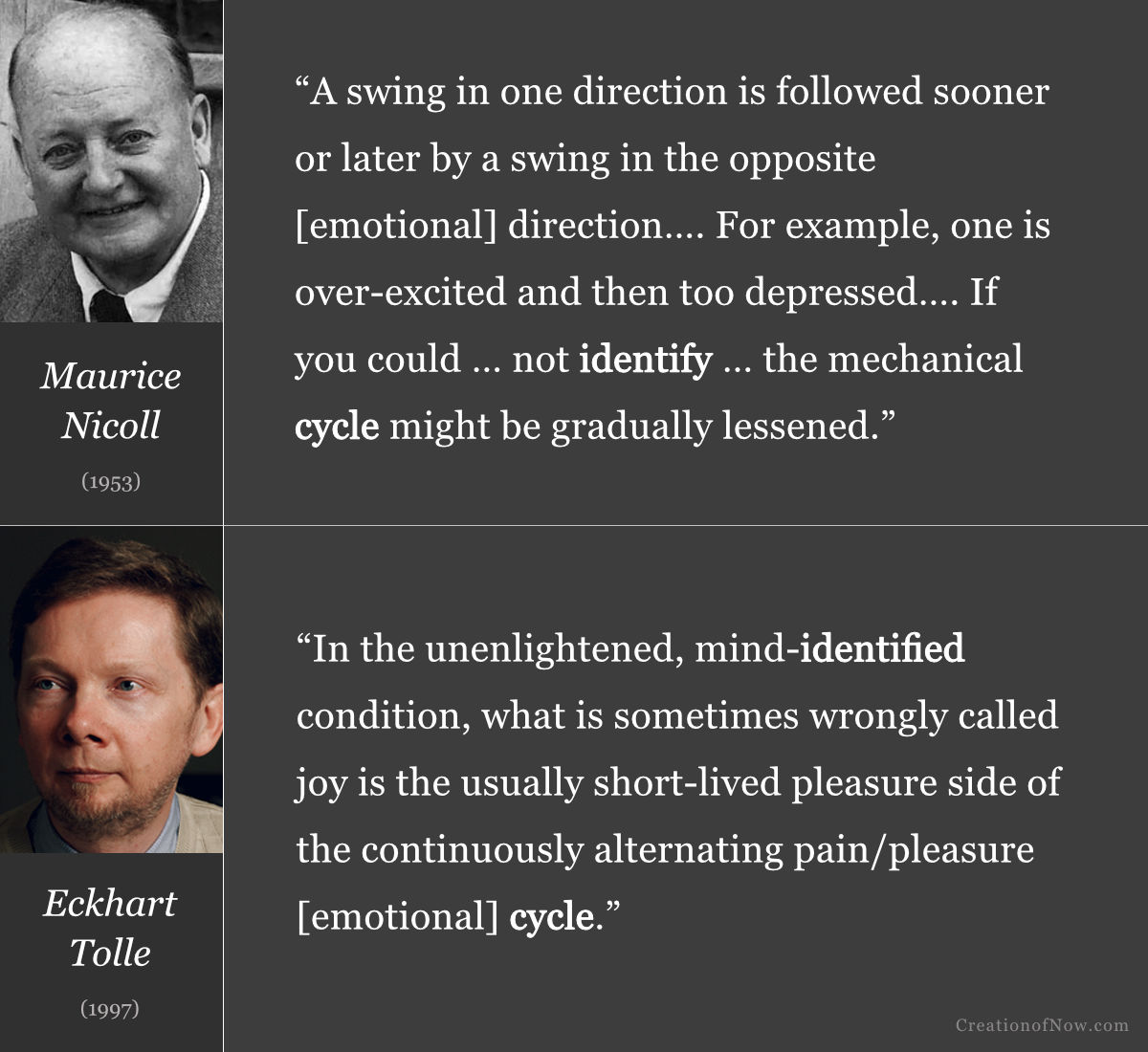
We stay psychologically trapped in swings or cycles between opposite mental-emotional states by identifying with our emotions, Nicoll and Tolle convey.
Read the article this image was featured in here.
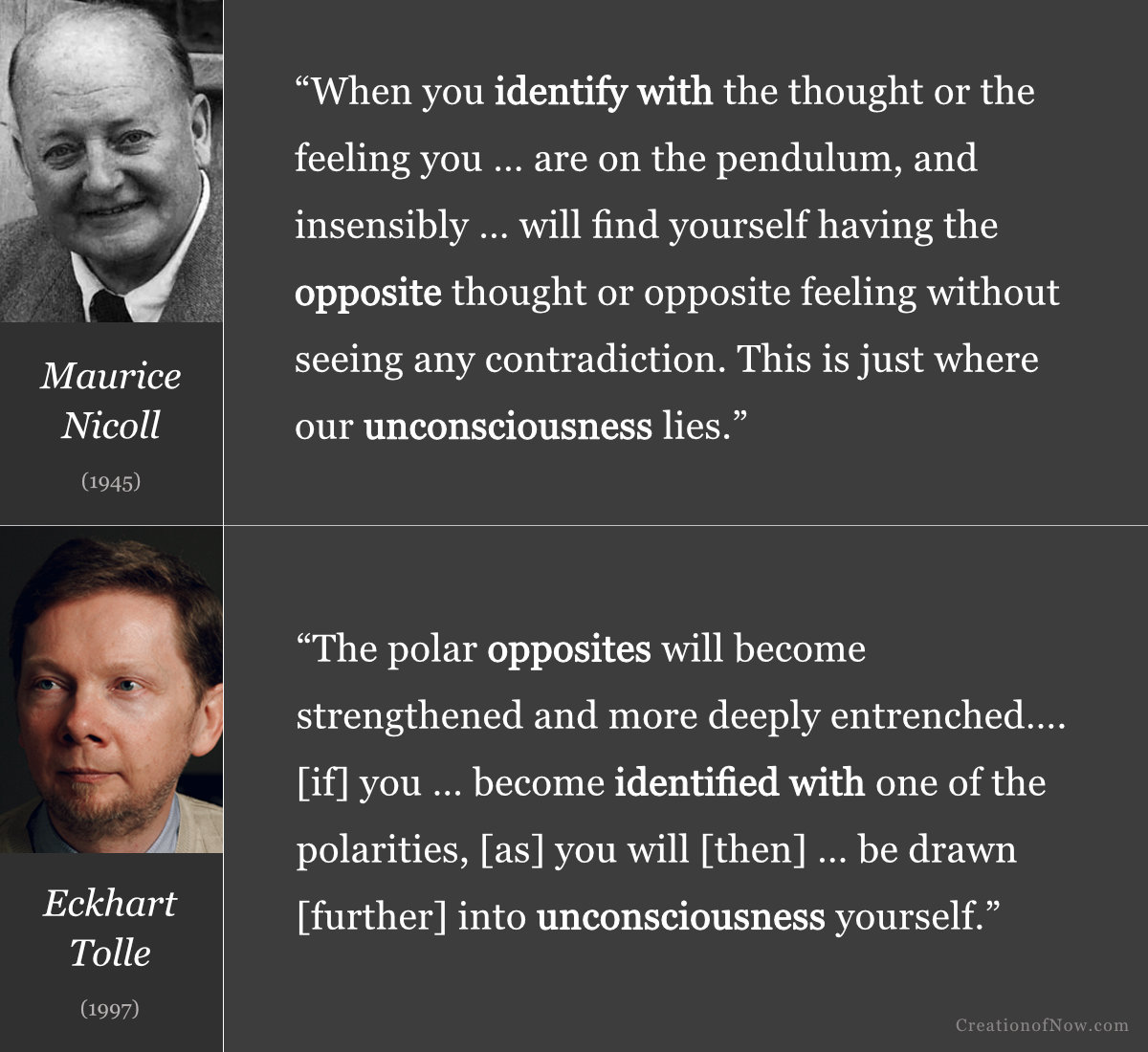
If you identify with one polarity, or side of the pendulum, you will unconsciously perpetuate both it and the opposite side or polarity, the authors suggest.
Read the article this image was featured in here.
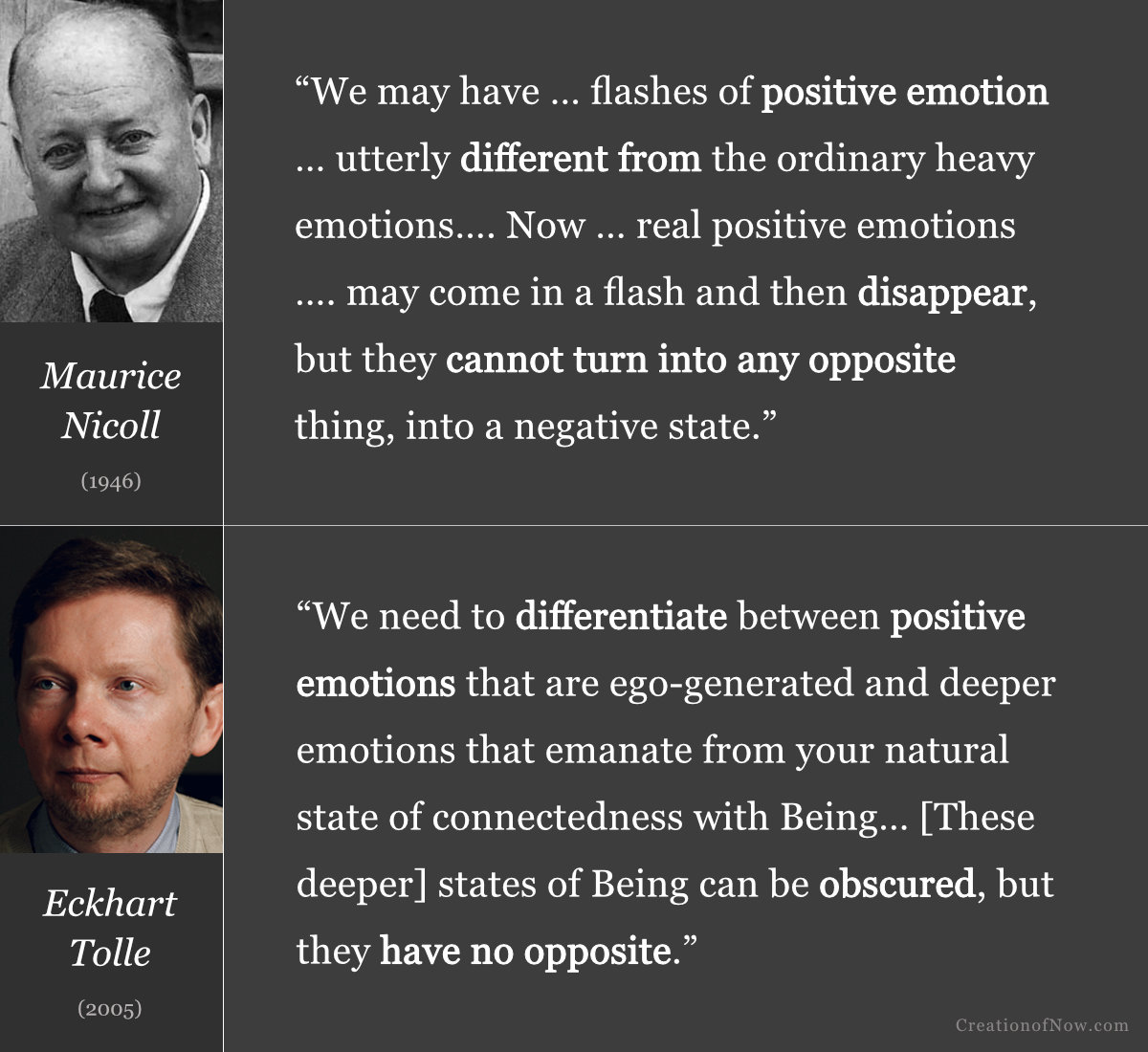
We can experience deeper or higher emotional states, different from the usual kind. These may disappear or be obscured, we are told, but exist beyond all typical opposites.
Read the article this image was featured in here.
Because higher or deeper emotions or states have no opposite, they can never become an opposite. Real love, unlike the pseudo kind, cannot turn into hate, Nicoll and Tolle say.
Read the article this image was featured in here.
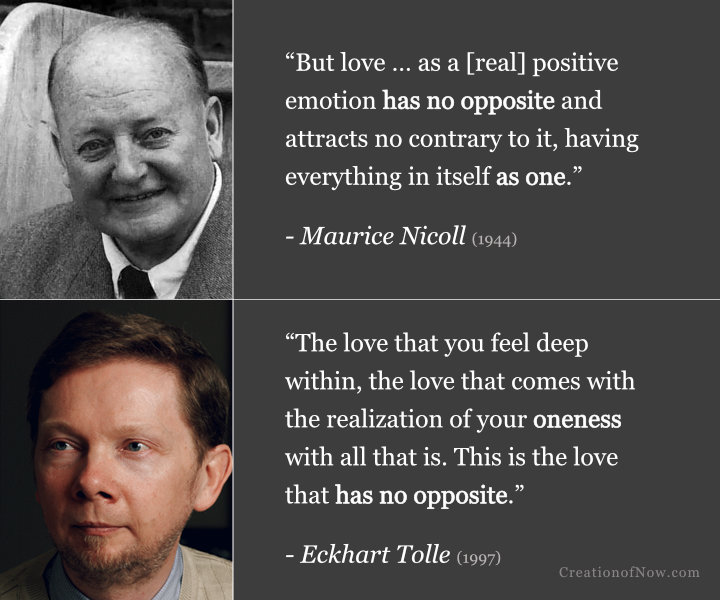
Real love “has no opposite,” write Tolle and Nicoll, and brings a sense of “oneness” or being “as one.”
Read the article this image was featured in here.
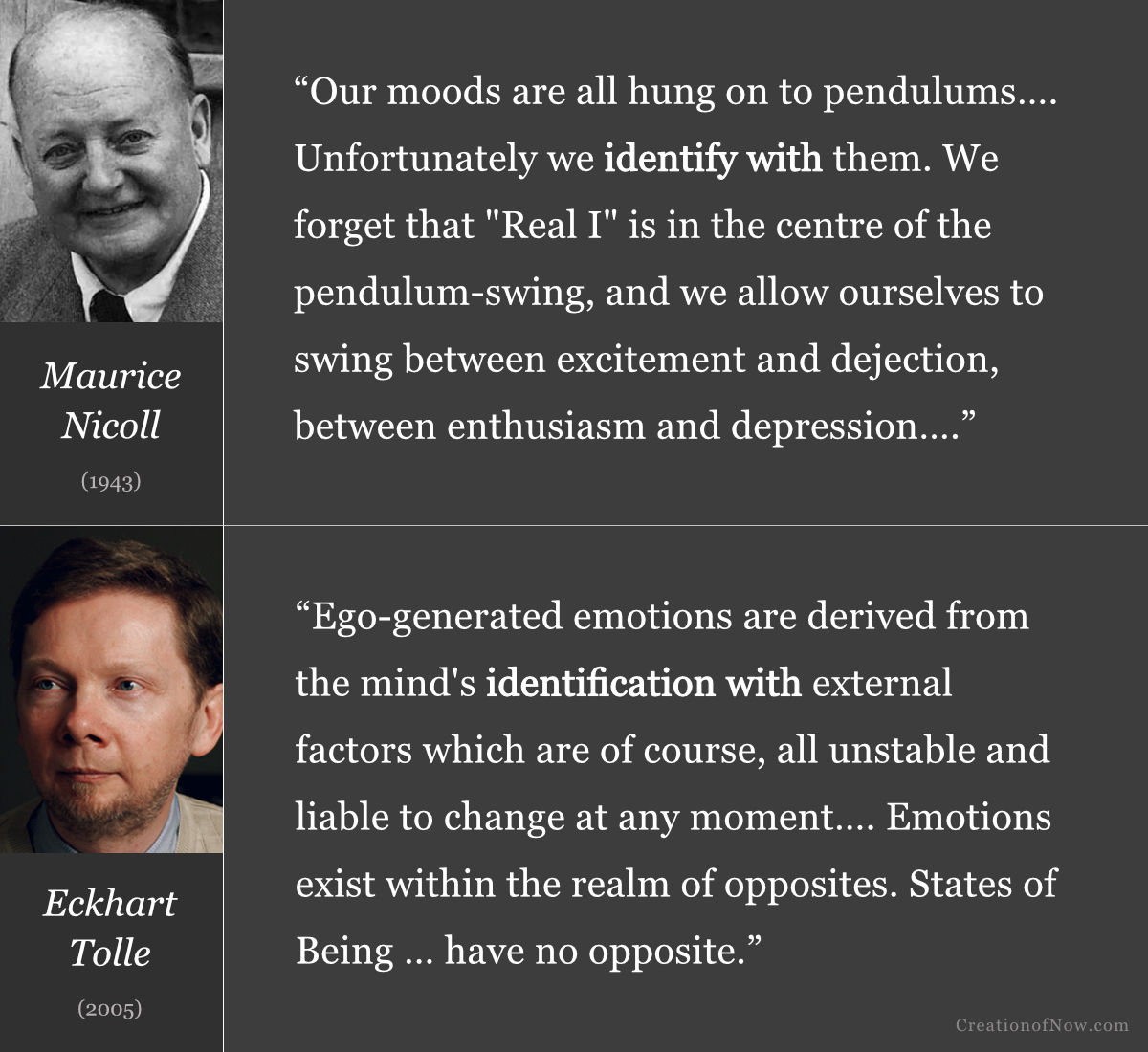
We identify with changing emotions and moods that swing between opposites, but our “Real I” or “Being” is not found in these cycles, the authors suggest.
Read the article this image was featured in here.
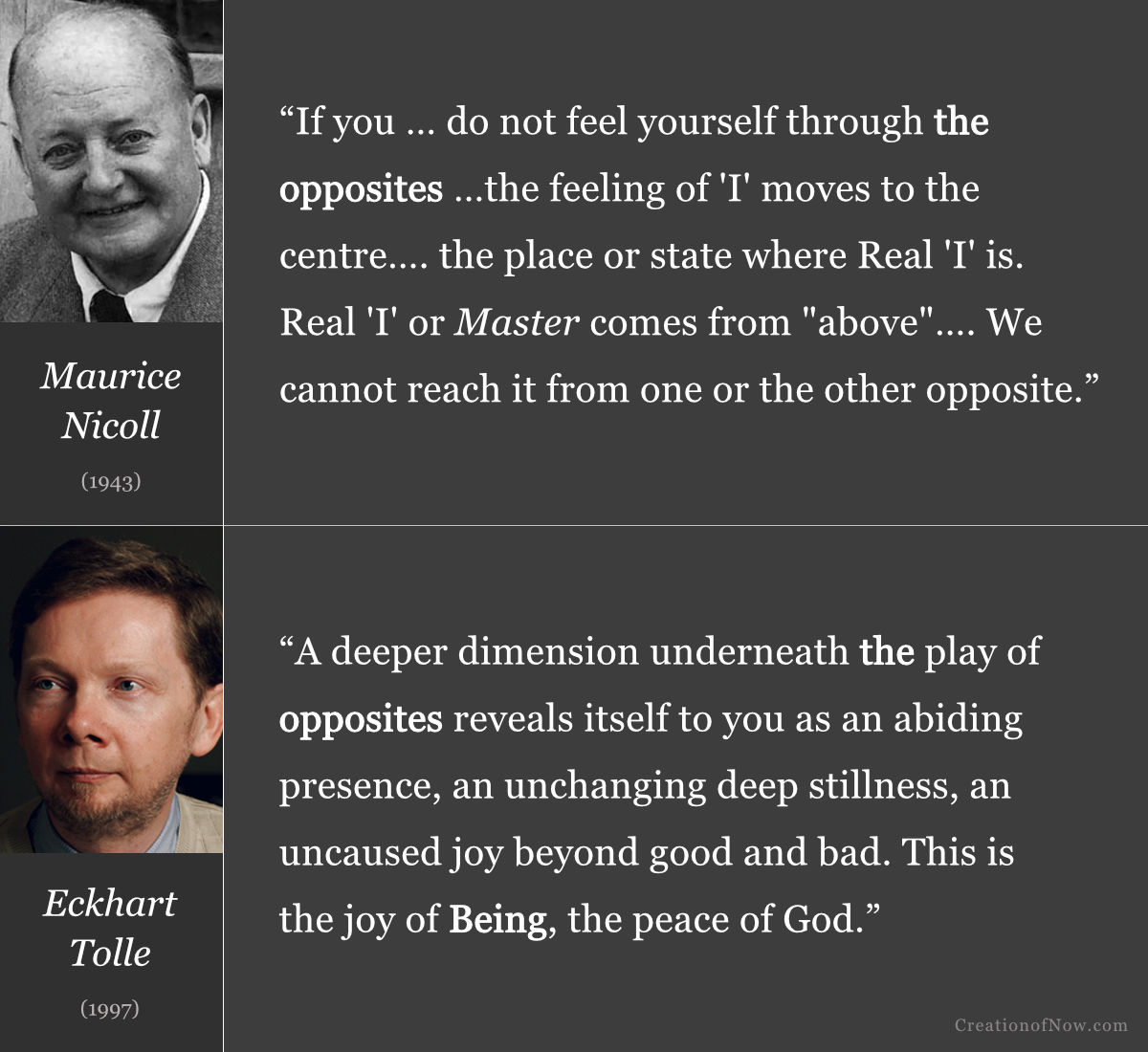
Our real self or Being cannot be reached or revealed in either emotional opposite, Nicoll and Tolle convey. It is beyond the opposites.
Read the article this image was featured in here.
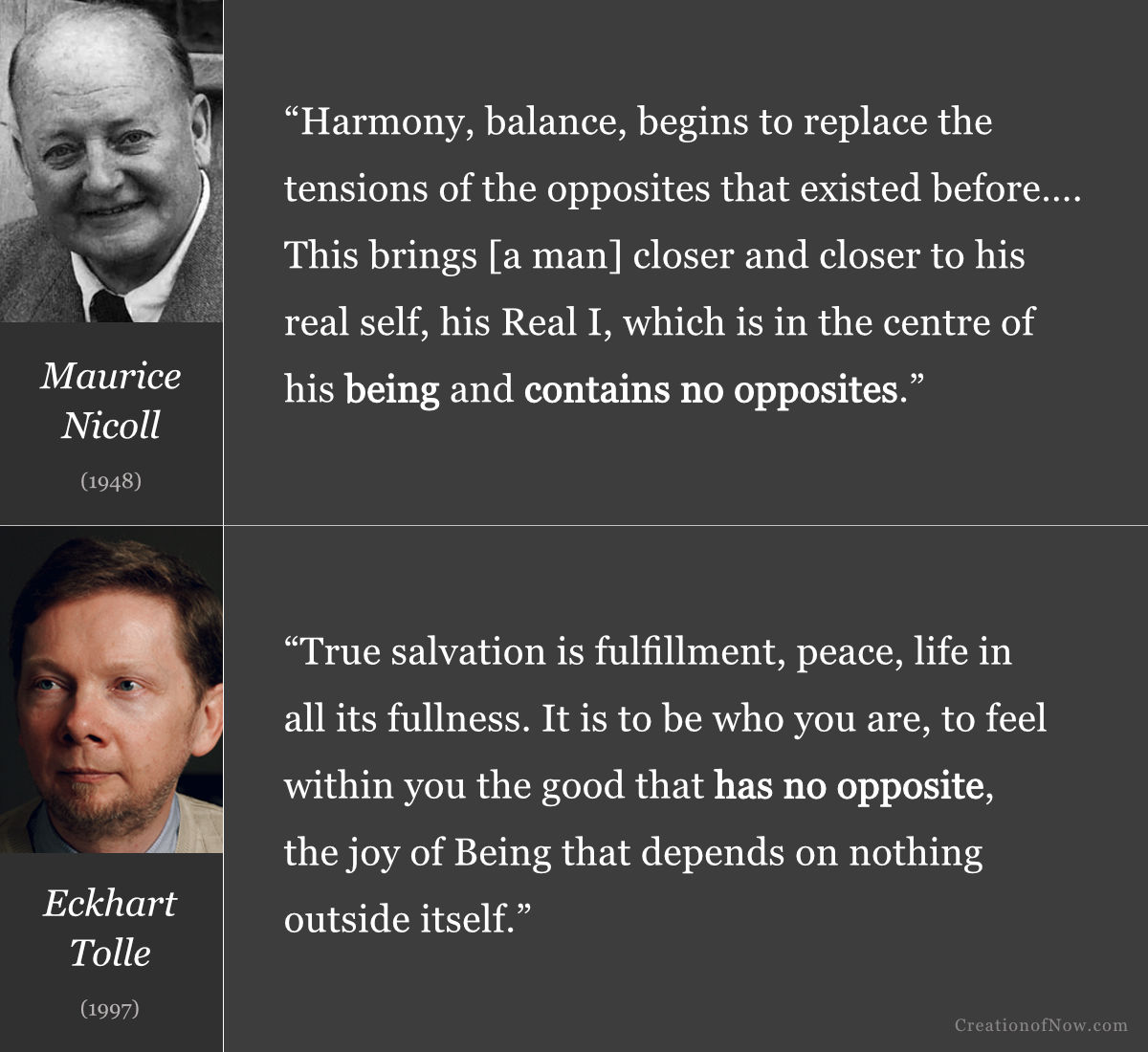
Our real self or Being has no opposites, Nicoll and Tolle tell us.
Read the article this image was featured in here.
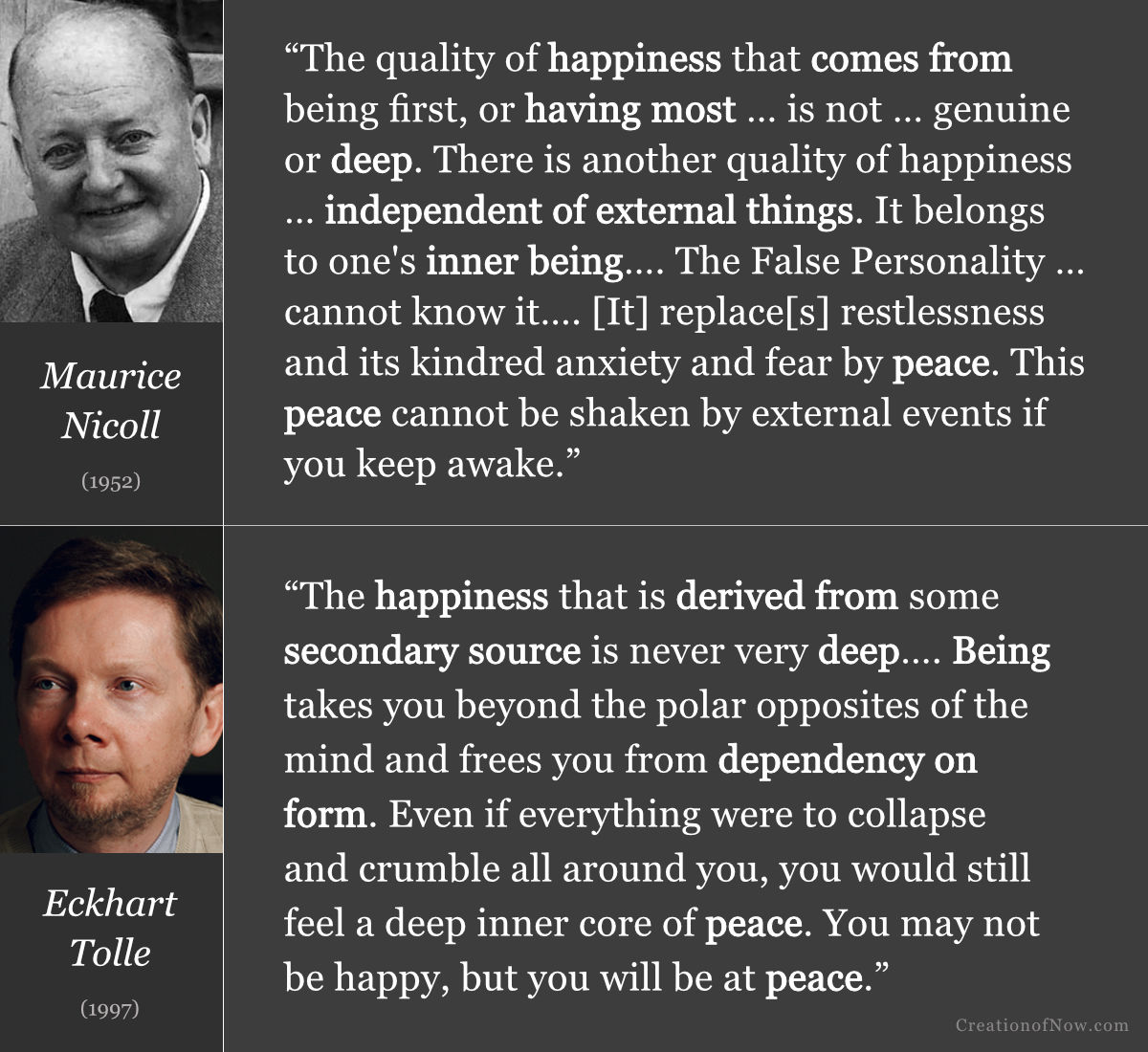
The happiness derived from attaining things isn’t deep, but the peace from one’s inner being is independent of anything else, and remains whatever happens—if you stay awake or present within, the authors convey.
Read the article this image was featured in here.
Eckhart Tolle and Maurice Nicoll – mixed reel
This slideshow compares similar statements made by Nicoll and and Tolle on a variety of topics.
“ ‘The power of self-observation is an inner sense, rarely used. . . . We are unaware of what we are doing.’
- Maurice Nicoll (1952)
“ ‘You need to have some power of self-observation, which is another word for awareness.’
- Eckhart Tolle (2008)
“ ‘Self-observation is an act of attention directed inwards—to what is going on in you.’
- Maurice Nicoll (1943)
“ ‘Monitor your mental-emotional state through self-observation. . . . Direct your attention inwards.’
- Eckhart Tolle (1997)
“ ‘Notice what thoughts crowd into your mind . . . what they are saying, what unpleasant emotions surge up, and so on.’
- Maurice Nicoll (1943)
“ ‘Have a look inside yourself. What kind of thoughts is your mind producing? What do you feel?’
- Eckhart Tolle (1997)
“ ‘You must try to observe everything in yourself at a given moment—the emotional state, thoughts, sensations, intentions, posture, movements . . . and so on.’
- Maurice Nicoll (1941)
“ ‘Give attention to your behavior, to your reactions, moods, thoughts, emotions, fears, and desires as they occur in the present.’
- Eckhart Tolle (1997)
“ ‘The impressions gained from self-observation are . . . from an internal sense . . . a silent witness, a spectator of what goes on in me.’
- Maurice Nicoll (1952)
“ ‘A clear and still space of pure awareness . . . come[s] into being . . . the silent witness, the watcher.’
- Eckhart Tolle (1997)
“ ‘People . . . mistake thinking for observing. To think is quite different from observing oneself.’
- Maurice Nicoll (1943)
“ ‘[This] does not mean that you start thinking about it. It means to just observe.’
- Eckhart Tolle (1997)
“ ‘Observe . . . without criticism or analysis.’
- Maurice Nicoll (1943)
“ ‘Don’t judge or analyze what you observe.’
- Eckhart Tolle (1997)
“ ‘By practice you can observe your mood more and more distinctly.’
- Maurice Nicoll (1953)
“ ‘With practice, your power of self-observation, of monitoring your inner state, will become sharpened.’
- Eckhart Tolle (1997)
“ ‘Now if you are observing your thoughts and your emotions . . . you may [after a time] laugh at these thoughts, these emotions, and wonder why you took everything in that way.’
- Maurice Nicoll (1945)
“ ‘When you detect egoic behavior in yourself, smile. At times you may even laugh. How could humanity have been taken in by this for so long?’
- Eckhart Tolle (2005)
“ ‘You are not your thoughts.’
- Maurice Nicoll (1943)
“ ‘You are not your mind’
- Eckhart Tolle (1997)
“ ‘Consciousness is not the same as your thought, feeling or sensation. Through consciousness you become aware of them as contents, but . . . consciousness can exist without any content.’
- Maurice Nicoll (1951)
“ ‘Thinking and consciousness are not synonymous. . . . Thought cannot exist without consciousness, but consciousness does not need thought.’
- Eckhart Tolle (1997)
“ ‘By true self-observation we let a ray of light into ourselves. . . . Not . . . physical light but the light of Consciousness.’
- Maurice Nicoll (1945)
“ ‘Just observe the emotion. . . . Attention is like a beam of light – the focused power of your consciousness.’
- Eckhart Tolle (1997)
“ ‘By the method of self-observation . . . [we] bring this not yet known side of ourselves into the light of consciousness.’
- Maurice Nicoll (1946)
“ ‘You are the watcher, the observing presence. If you practice this, all that is unconscious in you will be brought into the light of consciousness.’
- Eckhart Tolle (1997)
“ ‘Nothing can change in us unless it is brought into the light of self-observation—that is, into the light of consciousness.’
- Maurice Nicoll (1943)
“ ‘If you don’t bring the light of your consciousness into the [emotional] pain, you will be forced to relive it again and again.’
- Eckhart Tolle (1997)
“ ‘Get to work and make it conscious by means of candid self-observation.’
- Maurice Nicoll (1952)
“ ‘Make it conscious. Observe the many ways in which unease, discontent, and tension arise within you.’
- Eckhart Tolle (1997)
“ ‘When you become conscious of something that you constantly say or feel or think . . . it begins to be ‘not I’. . . . You rise a little in your level of being through . . . the light of consciousness.’
- Maurice Nicoll (1949)
“ ‘By making this pattern conscious, by witnessing it, you disidentify from it. In the light of your consciousness, the unconscious pattern will then quickly dissolve.’
- Eckhart Tolle (1997)
“ ‘Whatever we bring into the light of consciousness loses the power it has over us if it remains unconscious.’
- Maurice Nicoll (1952)
“ ‘Anything unconscious dissolves when you shine the light of consciousness on it.’
- Eckhart Tolle (1997)
“ ‘The remedy is the light of consciousness.’
- Maurice Nicoll (1952)
“ ‘The light of consciousness is all that is necessary.’
- Eckhart Tolle (2005)
“ ‘“Why beholdest thou the mote that is in thy brother’s eye but considerest not the beam that is in thine own eye?” . . . This is a pretty good example of what the Work says about observing yourself instead of finding fault with everyone else.’
- Maurice Nicoll (1950)
“ ‘The egoic compulsive habit of faultfinding and complaining about others. Jesus referred to it when he said, “Why do you see the speck that is in your brother’s eye, but do not notice the log that is in your own eye?”’
- Eckhart Tolle (2005)
“ ‘The faults we dislike most in others are usually those that we display ourselves without being conscious of them.’
- Maurice Nicoll (1951)
“ ‘The particular egoic patterns that you react to most strongly in others . . . tend to be the same . . . that are also in you, but that you are unable or unwilling to detect.’
- Eckhart Tolle (2005)
“ ‘Everything that you are so critical of in others is expressing itself in you.’
- Maurice Nicoll (1946)
“ ‘Anything that you resent and strongly react to in another is also in you.’
- Eckhart Tolle (2005)
“ ‘People project [their] unaccepted psychology on to others.’
- Maurice Nicoll (1950)
“ ‘[You] project your own unconsciousness onto another person.’
- Eckhart Tolle (1997)
“ ‘You take life-realities and your reaction to them as the same. They are not the same.’
- Maurice Nicoll (1951)
“ ‘They cannot tell the difference between an event and their reaction to the event.’
- Eckhart Tolle (2005)
“ ‘Life is a changing kaleidoscope of events. . . . The difficulty is that people take life and their reactions to life as the same thing.
- Maurice Nicoll (1948)
“ ‘The ego cannot distinguish between a situation and its interpretation of and reaction to that situation.’
- Eckhart Tolle (2005)
“ They find it difficult to realize that . . . a thunderstorm, is not the same as their mechanical reaction to it. . . . The storm, which . . . is a neutral, impersonal thing, and their mechanical reactions . . . [of], say, alarm, seem identical to them.’
- Maurice Nicoll (1948)
“ You might say, ‘What a dreadful day,’ without realizing that the cold, the wind, and the rain or whatever condition you react to are not dreadful. They are as they are. What is dreadful is your reaction.’
- Eckhart Tolle (2005)
“ ‘We have the power of choice internally [by observing our state].’
- Maurice Nicoll (1945)
“ ‘With the seeing [of inner dysfunction] comes the power of choice.’
- Eckhart Tolle (2005)
“ ‘Try to notice where you are in yourself at this moment, to what thoughts you are consenting. . . . Have you yet attained any power of inner freedom from . . . your mechanical thoughts and feelings induced by external circumstances?’
- Maurice Nicoll (1943)
“ ‘By watching the mechanics of the mind, you step out of its resistance patterns, and you can then allow the present moment to be. This will give you a taste of the state of inner freedom from external conditions.’
- Eckhart Tolle (1997)
“ ‘You are entirely dependent on the events of external life. . . . How can you think that inner peace depends on what happens to you?’
- Maurice Nicoll (1950)
“ ‘[Ordinary] happiness depends on conditions being perceived as positive; inner peace does not.’
- Eckhart Tolle (1997)
“ ‘In our psychological world . . . we have gradually to become more responsible.’
- Maurice Nicoll (1945)
“ ‘You are responsible for your inner space; nobody else is.’
- Eckhart Tolle (1997)
“ ‘You become responsible . . . when one begins to apply [this Work] to oneself and to the state one is in at any moment.’
- Maurice Nicoll (1945)
“ ‘To end the misery … you have to start with yourself and take responsibility for your inner state at any given moment.’
- Eckhart Tolle (2005)
“ ‘The diagram of the Cross . . . represents a single moment in a man’s life. In this single moment the vertical line is cut across by the horizontal line of Time. . . . The point of intersection of the vertical with the horizontal line is now.’
- Maurice Nicoll (1942)
“ ‘There’s the vertical dimension and the horizontal dimension. One could even say that the cross . . . symbolizes that also. . . . Most people only know the horizontal dimension, unaware of the vertical dimension which is . . . the present moment.’
- Eckhart Tolle (2017)
“ ‘It is only this feeling of the existence and meaning of the direction represented by the vertical line that gives a man a sense of now.’
- Maurice Nicoll (1942)
“ ‘And so you enter the vertical dimension by being—becoming present, by bringing your attention into the now.’
- Eckhart Tolle (2008)
“ ‘Eternity is vertical to Time and this is . . . the feeling of oneself now. . . . To remember oneself the feeling of now must enter. . . . Eternity is always in now.’
- Maurice Nicoll (1946)
“ ‘Entering the vertical dimension requires a high degree of Presence. The Now needs to be the main focus of our attention.’
- Eckhart Tolle (2016)
“ ‘[Real] I dwells in now, and not in passing-time.’
- Maurice Nicoll (1952)
“ ‘It is only now that you are truly yourself.’
- Eckhart Tolle (1997)
“ Real inner change is a development of essence . . . the most real and the deepest part of you.’
- Maurice Nicoll (1943)
“ “Discover and live from your true essence—what I sometimes refer to as the ‘Deep I.’”
- Eckhart Tolle (2021)
“ ‘Essence is not of passing Time. It is not a temporal thing. . . . [But external] life makes us identify with the Personality.’
- Maurice Nicoll (1946)
“ ‘Most humans . . . are unaware of their own essence and identify only with their own physical and psychological form. ‘
- Eckhart Tolle (2005)
“ ‘One is not the same as one's acquired Personality . . . this artificial figure that life has built up, and that one takes as oneself, not knowing any better.’
- Maurice Nicoll (1944)
“ ‘You behave and act as if . . . that were who you are. So you get trapped inside that conditioned personality. And whatever you do, then it's the personality [that] is acting out.’
- Eckhart Tolle (2008)
“ ‘This prison that [Gurdjieff] so often spoke about is first of all your Personality.’
- Maurice Nicoll (1944)
“ ‘Your personality, which is conditioned by the past, then becomes your prison.’
- Eckhart Tolle (2005)
“ ‘The Personality . . . is not you. . . . but it calls itself I. It says I to you and you say I to it.’
- Maurice Nicoll (1946)
“ ‘What you usually refer to when you say 'I' is not who you are.’
- Eckhart Tolle (2005)
“ ‘Essence cannot be stripped off. The real person, the person that remains after Personality is removed, is the Essence.’
- Maurice Nicoll (1946)
“ ‘Whatever is real or of true value in your personality is your true nature shining through. This is never lost.’
- Eckhart Tolle (1997)
“ ‘Essence is the indestructible part of us.’
- Maurice Nicoll (1944)
“ ‘I know that the essence of who I am . . . is indestructible.’
- Eckhart Tolle (2008)
“ ‘The Gospels speak of a peace passing all understanding. Have you got this inner peace?’
- Maurice Nicoll (1948)
“ ‘Inner peace and serenity . . . come from a very deep place. . . . It is “the peace of God, which passes all understanding.”’
- Eckhart Tolle (1997)
“ ‘The quality of happiness that comes from being first, or having most . . . is not . . . genuine or deep.’
- Maurice Nicoll (1952)
“ ‘The happiness that is derived from some secondary source is never very deep.’
- Eckhart Tolle (1997)
“ ‘Love . . . as a [real] positive emotion has no opposite and attracts no contrary to it, having everything in itself as one.’
- Maurice Nicoll (1944)
“ ‘The love that you feel deep within, the love that comes with the realization of your oneness with all that is. This is the love that has no opposite.’
- Eckhart Tolle (1997)
Identification | Psychological Projection
The False Self | Essence and Personality
The Now | Eckhart Tolle & Barry Long
The Time/Pain Body & Emotional Centre/Body
View main quote image categories:
Self-Observation | Spiritual Psychology
Negativity Within | Law of Opposites